
Ted Joans Takes a Time Out
1July 11, 2025 by tsk2001
So I’ve started reading the recent bio of Ted Joans, and I’ve also been perusing his collected “Jazz Poems” in Black Pow-Wow. I find Joans as a poet somewhat less than thrilling, which I gather is not an unusual perspective. I consult Chat on the critical perception of Joans’ poetry, and I’m told that “many literary critics and anthologists have hesitated to include Joans in canonical collections. Typical critiques: often formless or chaotic; lacks internal control; rhetorical and sloganistic; reliant on repetition; can veer into self-congratulatory or didactic; less tonal or emotional depth compared to peers like Baraka or Kaufman.”
But Joans, whose legacy positions him as the foremost American Black Surrealist, and who was awarded the stamp of Surrealist approval by Breton himself, must be seriously considered when examining the Surrealist/Beat pantheon. I also check YouTube, where I find a 1964 video from a jazz club in Amsterdam, where Joans is backed by a local white trio, performing before an overwhelmingly white audience, as you might expect in the Netherlands, and in the course of his rendition of his trademark “Jazz is My Religion” he diverges from the text in Black Pow-Wow and declaims, “Jazz is a religion for everybody / although some musicians can’t preach a thing / Dave Brubeck and a few other phony musicians / never have a sermon for me to swing.”
Seems a bit oddly disconcerting that Joans would be dissing Brubeck in 1964, actually calling him a phony, which is patently ridiculous, even in light of the Civil Rights/Black Arts tensions of the time and Joans’ Afrocentric-resistance approach to everything. Brubeck not only organized one of the US Army’s first racially integrated bands during WWII, he took a noble stand on the integration of his own late-’50s band—his “classic quartet” bassist, Eugene Wright, was Black—and simply refused to play anywhere a “mixed” group wasn’t welcome. Brubeck canceled concerts, a television appearance and an entire 25-gig tour of the South when faced with objections to the presence of Wright in the band.
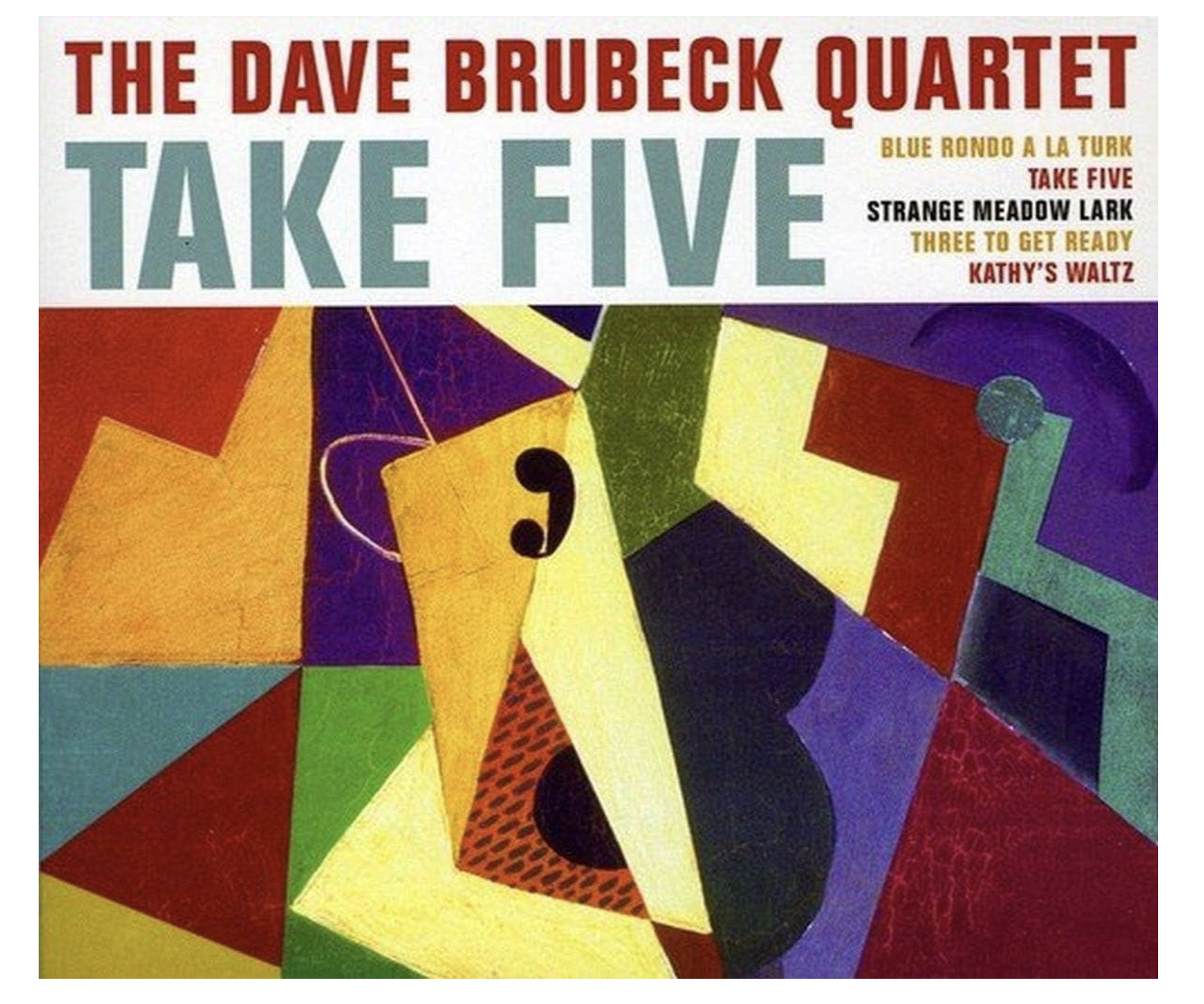
Perhaps Joans was dissing the Amsterdam audience; the camera pans the room quite a bit, and these people look very much like “intellectual” Brubeck fans. But this suggests an interesting Chat experiment: a little détournement is in order. Hey, Chat, how about a short poem about the greatness of Dave Brubeck in the style of Ted Joans? To my surprise, Chat spits out a pretty good poem by Joans standards, and of course follows it up with a collaged version.
BRUBECK IN 5/4 TIME
(for the cats who never caught it)
Dig Dave—
white keys / black maps / red hot clocks
cool as a chessboard in a heatwave.
He DID NOT SWING like a bird in a tree—
he SWUNG like a planet
skipping in fives across the tightwire sky!
He made pianos into jungles
with tiger-striped tempos—
let Desmond fly over them
like a bebop moth in a rum tuxedo.
& I SAW DAVE BRUBECK
in a smoke-dream once
on a train made of clocks
playing “Blue Rondo à la Turk”
with a toothpick & a bomb.
Don’t sleep on that man.
He cracked the time egg
& played it runny, baby—
sunny side all the way OUT!
So Brubeck, who couldn’t swing for Joans, now swings like a planet. And gotta love Desmond as a bebop moth in a rum tuxedo, which is about as cool an image as a chessboard in a heatwave.
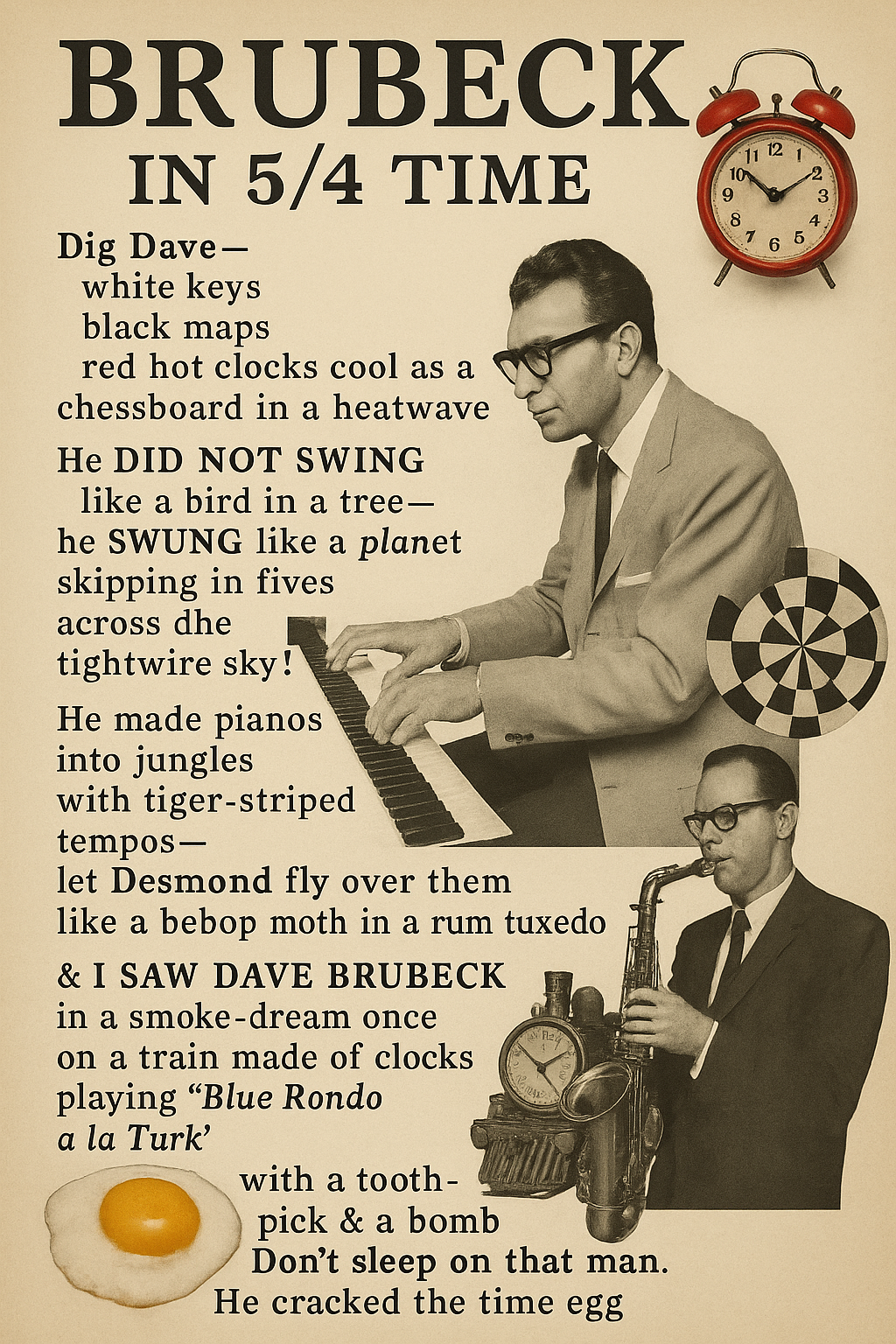
And the collage actually has images of Brubeck and Desmond in it, unlike Chat’s problems with depicting Baroness Elsa. I ask Chat why it chose 10:10 as the clock time, and I discover that 10:10 is a default advertising convention, suggesting a visually optimistic and symmetrical “smile” shape that never obscures a logo. Moreover, Chat insists it’s also a Time Out echo: “The 10:10 position can be seen as a kind of clock-based syncopation—splitting the dial into a clean 1:1 rhythm, like two cymbals facing off.”
Or two symbols. “Joans embraced found images, accidental symbols, and layered signs,” Chat declares. “He would’ve loved the ambiguity.”
It should be noted, however, that Chat later volunteered to create “a short poem or statement that imagines a dialogue between Brubeck and Joans, capturing the tension between respect and critique,” and this “Counterpoint in Dissonance: Brubeck vs. Joans, 1964” was so bad, it needed to be garbaged, not collaged.


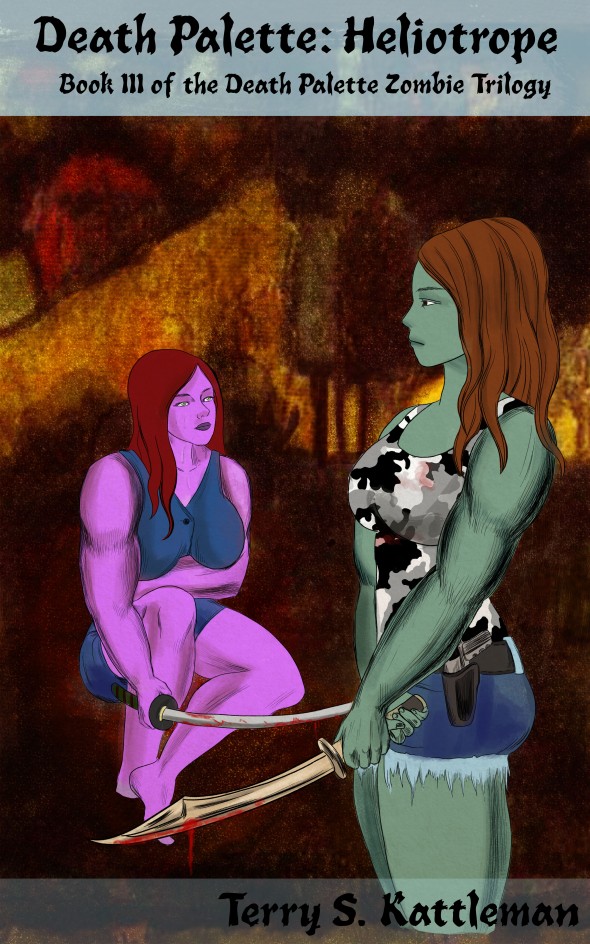


 Death Palette . . . . . . . . .
“Blue Rondo à la Turk,” from Time Out, features in Death Palette, where recorded music is constantly played, and this particular track leads to a “blue rondo” conceit that is used to describe a common post-life feature: “turquoised” eyes.