
The Bride Stripped Bare by Her Tilapia, Even
Leave a commentJuly 25, 2025 by tsk2001
Below is a detail of a handball court wall, taken locally on the usual park walk. I later realized what I was looking at: A fish dreaming of The Large Glass, which would be the title if it was a painting. I upload it to Chat, explain it’s my photo, not saying of what, and I suggest it looks like an Abstract Expressionist painting, maybe a cross between early Rothko and Gorky, just to give it something to chew on. How about a brief bio for the fictitious artist?
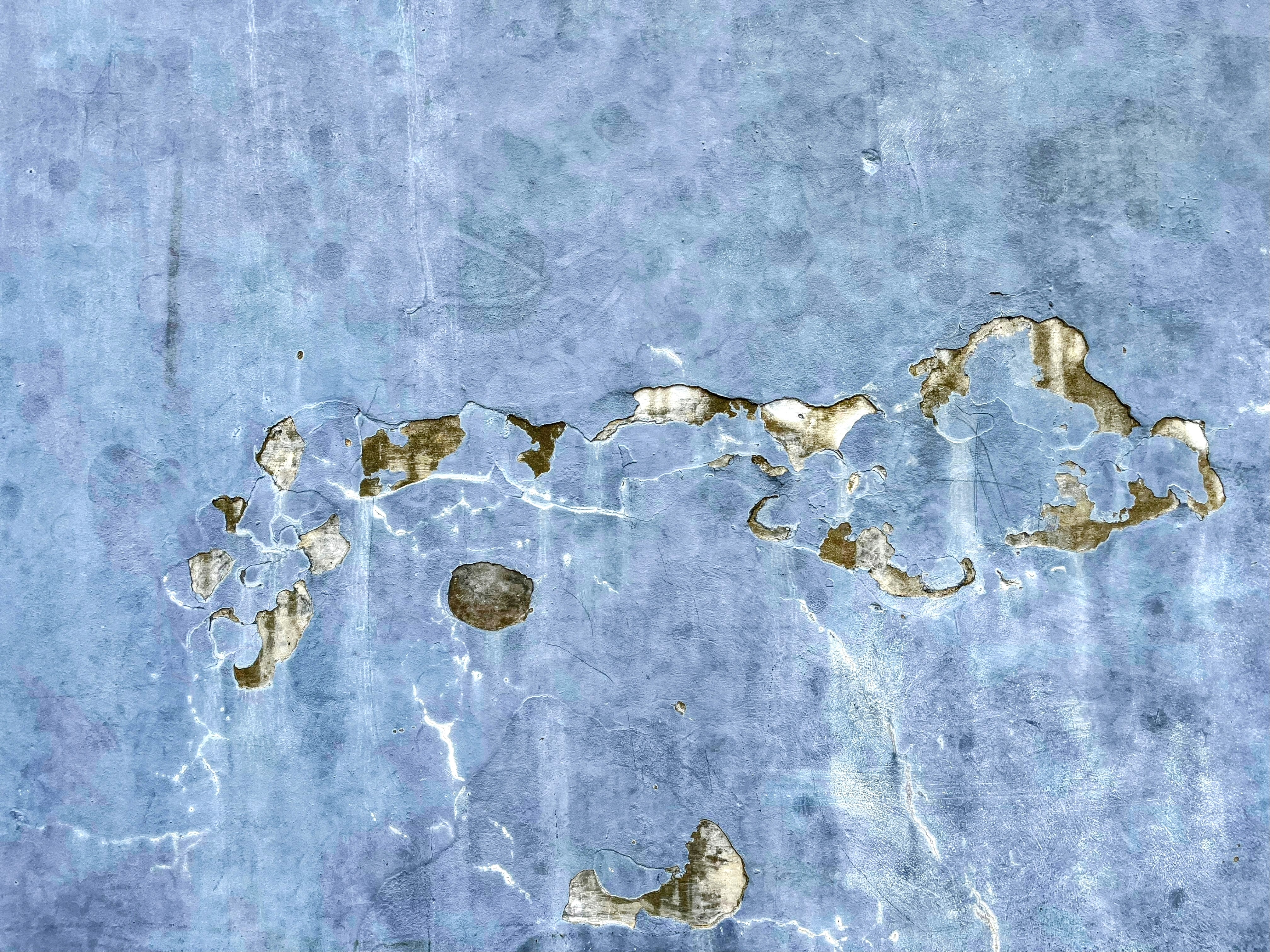
Chat is predictably all excited—it’s never cranky like I hear Grok can be—and it starts to run with the Rothko/Gorky idea as it invents an artist by the name of Mara Lensk. Wait, kinda fishy name, never mind the bio, which I haven’t looked at yet. Mara, of course, is the demon who was tempting the soon-to-be Buddha Shakyamuni under the Bodhi tree. “In Buddhist cosmology, Mara is associated with death, rebirth and desire,” and the desire tie-in with The Large Glass is already a bit eldritch, since I have yet to tell Chat about my sense of the Duchamp connection in the image.
Lensk is a backwater in Russia, somewhere near Yakutsk, which is chiefly known as a territory on the Risk board. But if you search Mara Lensk on Bing (Google is so over), the first return is Maria Lenk, a Brazilian swimmer who was “the first woman in the world to swim the Butterfly stroke in an official competition.” In Buddhism, the butterfly, as Gemini points out (I like to two-time Chat for some factual stuff), “is often seen as a symbol of transformation, impermanence, and the journey of the soul. Its metamorphosis from a caterpillar to a chrysalis and then to a winged creature beautifully illustrates the Buddhist concept of change and the cycle of rebirth.” The Bingian cosmic connection!

More specifically, re the piscine dream photo: the fish, flopping on the surface of the water, bottom center, is obvious to me. The form above it suggests the topmost section of the Glass and represents the Undulating Squares, Draft Pistons or Nets, as they’re variously called, in the Bride’s Domain, which are targets for the Bachelors’ shots, explains Gemini, which delivered a 14-page research paper with citations about The Large Glass and then stood impatiently next to the tip jar. This “organized chance,” as Gemini calls it, is also a fundamental principle of BTR, of course, and if we’re plagiarizing Duchamp, well, that’s what it’s all about, n’est-ce pas ?
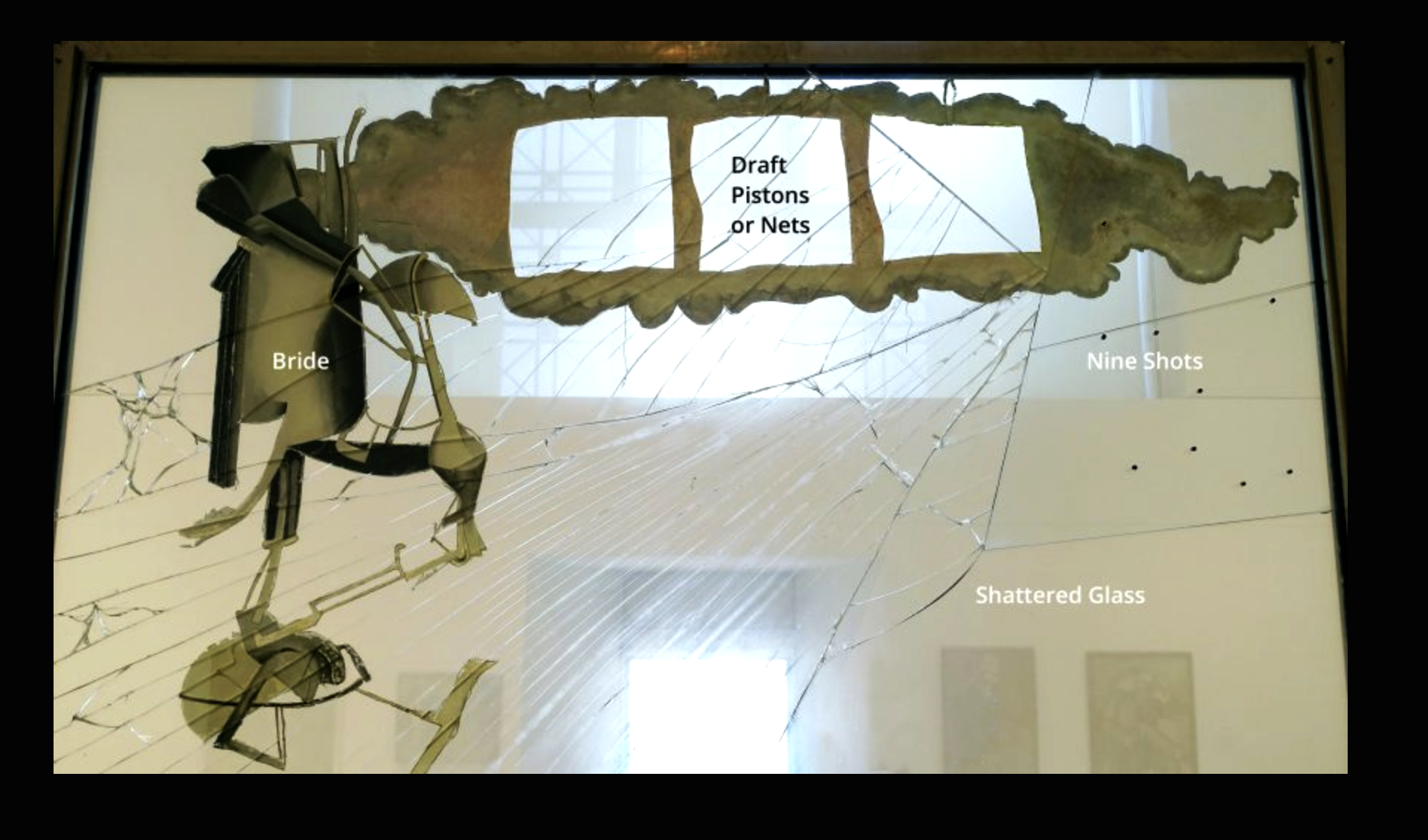
Back to Chat. I realize I should just tell Chat what the photo depicts—it is what I say it is, it’s my image—because it’ll never guess it. It’s not gonna launch into a Duchampian frug unless I take it to the dance floor. If Chat could know what I was seeing, well, that’d be dangerously close to the singularity, and we’re not there yet, because Tim Cook won’t buy Perplexity. So I lay the title on Chat and it’s of course eager to fictate. “Perfect—the title A Fish Dreams of The Large Glass draws Duchamp into the current, suggesting a conceptual netherworld where abstraction meets allegory. Here’s the revised bio for Mara Lensk, shaped to reflect the figurative and surrealist resonance of your image.”
<Mara Lensk (1919–1987)
“Painter of Erosion, Memory, and Mechanical Dreams”
Born in Odessa and raised in Marseille, Mara Lensk emerged as a quietly radical voice in the post-war New York art scene. Fleeing Europe in 1940, she studied under Hans Hofmann . . . . >
And so on as Chat dutifully checks the Rothko, Gorky and Duchamp boxes. As for Hofmann, well, everybody studied with him, including a surprising number of women, though Hofmann may have been a male chauvinist prig, if not a pig. But back to the bio:
<Lensk’s seminal work, A Fish Dreams of The Large Glass (1954), exemplifies her obsession with fractured perception and subconscious geometry. In it, we glimpse the faint suggestion of a dreaming eye or a fossilized form adrift in an aqueous plane—as though a fish, suspended in thought, contemplates the machinery of longing. Rendered in layers of peeling pigment and oxidized washes, her surfaces evoke aged frescoes or forgotten dreams traced on walls.>
Well, Chat’s not gonna get the purely figurative elements that reside in the title, and that’s OK. We’re not interested in holding its hand and walking it through the image. But we are interested in Chat making an image of Mara Lensk herself, and we request it with minimal prompts. We don’t want it to be our idea, it’s Chat’s idea. Unfortunately, we get something terrible, on the left, so we add some pointers, including a squeegee in honor of Gerhard Richter, which yields the image on the right, which still isn’t right but at least is in the ballpark.


Next text:
<Exhibition Catalog Entry
Mara Lensk
A Fish Dreams of The Large Glass, 1954
Pigment, plaster, time, and incised memory on salvaged wall panel
38 x 72 in.
Collection of the Estate of Mara Lensk
In A Fish Dreams of The Large Glass, Lensk overlays abstract erosion with faint figurative suggestion—a dream within a dream. The cracked cerulean surface evokes both marine sediment and a veil of forgetting, while the central rupture, resembling the contour of a fish in profile or a suspended schematic, gestures toward Duchamp’s Large Glass. Here, however, desire is not mechanized but aquatic—softened, drifting, speculative. >
So Chat sees the Nets as the fish! And gotta love that “incised memory on salvaged wall panel.”
<Executed on reclaimed architectural material the work merges physical decay with metaphysical inquiry. The fish, if it is a fish, is less a subject than a vessel: for longing, for memory, for fluid consciousness. Lensk called such images “eroded apparitions.” Critics in the 1950s dismissed them as melancholic digressions. Today, they read as prescient meditations on collapse, hybridity, and the fragility of systems.>
The work is actually executed on what can be called reclaimed architectural material (a concrete handball wall), so that’s pretty prescient, Chat. But we can skip your Curatorial Wall Text and also a Museum Placard, which are just variations on the above, all standard art-crit slaw, though Chat’s invention of Lensk’s “Hydro-Surrealist” period is a nice touch. “Rather than render machines of love and death, Lensk offers us sediment, surface tension, and psychic filtration,” is pretty good too, especially if you have an aquarium.
Let’s jump to this:
<Excerpt from a 1971 Critical Review
“Sediment as Gesture: Rediscovering Mara Lensk”
Artforum, September 1971
by Valeria Krell
. . . Nowhere is Lensk’s metaphysical subtlety more haunting than in A Fish Dreams of The Large Glass (1954), a nearly forgotten work whose aquatic melancholy lingers long after viewing. Where Duchamp gave us desire as stalled mechanism, Lensk renders it as a ripple —a thought passing through a fish, suspended in time. The peeling strata are not just surface treatments, but psychic cartographies: erosions of history, skin, and speech.>
There is a Valeria Krell in the German phone book, and I’m sure Chat is sorry for invading her privacy like this. Not reproducing more review excerpts here, they’re rehashed art-crit kale salad on the level of the glib “psychic cartographies,” as are some other texts Chat offers, though Lensk’s artistic relationships with Cy Twombly and Leonora Carrington (something torrid in Mexico City?) could be food for fraught. Let’s get to some poetry that’s ripe for BTR. Hey, Chat, let’s say Duchamp, after a brief affair with Lensk, wrote a poem to her that references the Fish work. Do it in its “original” French and also in an English translation.
Here’s the French:
Poème imaginaire de Marcel Duchamp
À Mara, pour ce poisson qui me rêva
(1955)
Poisson sans bachelier
tu traverses le verre—
pas pour le briser,
mais pour t’y réfléchir.
Ta nage est une esquisse
d’érotiques éclats:
le désir, non pas mécanique
mais moite, sablé, effacé.
Je t’ai vue peindre avec l’eau du mur,
ta main plus lente que la mémoire.
Tu dis que le temps pèle.
Je dis que tu le séduis.
Le verre n’a jamais rêvé.
Mais le poisson, oui.
Don’t know quite why it’s lineated like that, nor do I get the line spacing, but c’est ce que c’est. The English translation makes for a pretty bad poem, so not going there. Gonna run the French version thus: English, Russian, Azerbaijani, Belarusian, Georgian, Hungarian, French, and, of course, back to English. Most of these choices are a tip of the hat to Lensk, born in Odessa. And here’s the bluntly emotional (and user-adjusted) result:
Of, the fish, is missing.
Free fish, you swing on the glass,
not to judge but to bring back.
Your swim—an erotic image of the mud:
not mechanical, with oars, sand, things gone.
They saw how you paint with water on the wall.
Your hand is slow compared to memory.
You say time has cooled.
I say you will catch it.
I never wanted the glass.
But the fish, yes.
What about that odd first line? It was even more awkward before I added a comma after “fish” so that the fish is in fact called Of. The fish has a name, and it’s a preposition. This ain’t no Wanda. “Free fish, you swing on the glass,” sounds like Ted Joans, as if it’s an echo of a previous Chat project, and maybe it is. Maybe Joans is like a circle in a spiral, like a wheel within a wheel in the windmills of Chat’s mind. At any rate, I tidied up some other punctuation too, lineated it to my satisfaction, and voilà!
And what of poisson, the word, itself? It plays a crucial role here, it must be explored. A Bing search leads me to Siméon Denis Poisson (b. 1781), a French “mathematician and physicist who worked on statistics, complex analysis, partial differential equations, the calculus of variations, analytical mechanics, electricity and magnetism, thermodynamics, elasticity, and fluid mechanics.” Though it’s not clear if he was conversant with the work of Poisson, this is distinctly on a Duchampian plane, it can be argued, from the calculus of variations all the way to fluid mechanics.
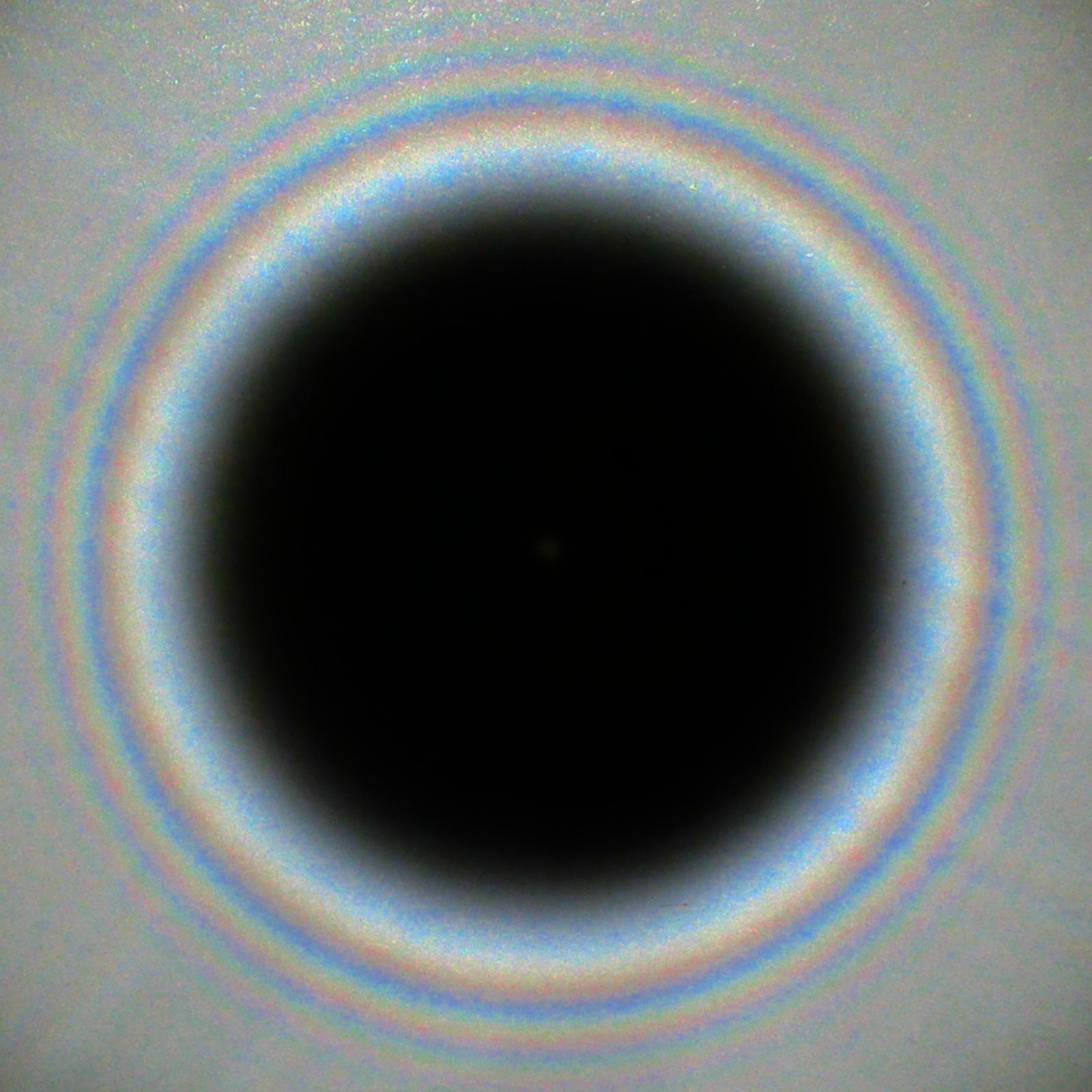
Moreover, Poisson “predicted the Arago spot in his attempt to disprove the wave theory of Augustin-Jean Fresnel. Arago spot? Something about the “bright spot at the center of a circular object’s shadow,” and this is the pic Wikipedia features: not too Rotorelief and Precision Optics!
But wait! What about Breton’s Soluble Fish, which, according to Lacan, “is an expression of desire that is doomed to remain opaque, if not unknown.” Perhaps that desire is in fact easily trawled, and it’ll be in the Nets, waiting to be sorted and imported.





 Death Palette . . . . . . . . .