
Young Hares Secured Against Cherry Trees: Bretonian Questions Abound
Leave a commentDecember 17, 2025 by tsk2001
I was in Philly on the weekend to see Dreamworld: Surrealism at 100. And of course to pay homage to Duchamp at the magic peepholes, but this is not about that. Or maybe it is. Maybe everything is about that. At any rate, I didn’t take many pics at the show (I bought the book), but I did take a rather casual shot of this vitrined Breton book of poems, which has a fetchingly amusing title and cover.

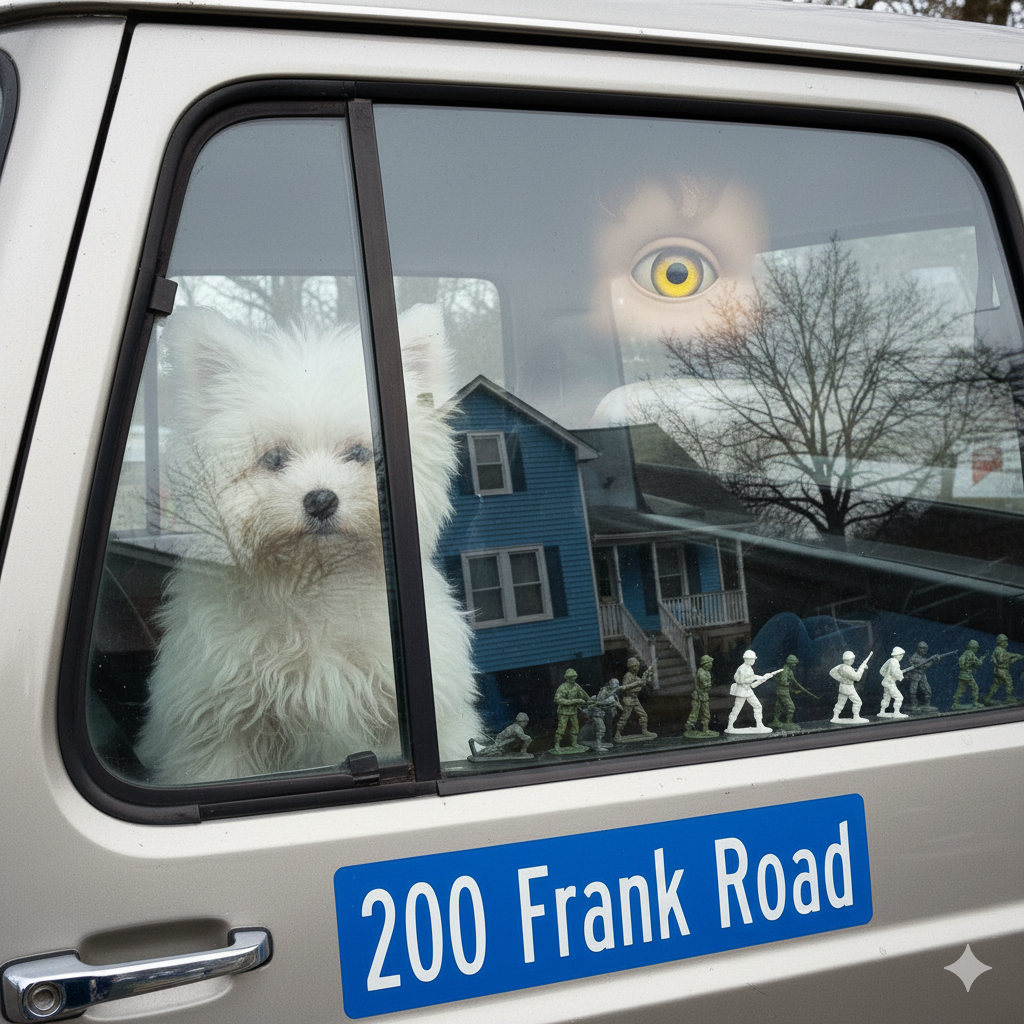
The next day, back home, I see this in a parking lot, which clearly has to be contemplated. It surely has something to do with Breton’s hare and, perhaps, Absolute Truth itself, hence the Frank Road address. There are no coincidences. I parked next to this guy for a reason, and it wasn’t the convenience of the spot. Though, I’ll admit, that was a weighty factor.

I find a PDF of the book, kindly made available for free download by the University of Michigan Press in what must be the dawning of a new age of academic enlightenment. I page through it and discover that this collection includes the famous “Free Union” list poem, which was “processed” here in an earlier post, but there is no poem that shares the book’s title. The notorious David Hare affair, which was indeed an affair featuring the Surrealist artist Hare and Breton’s wife and the mother of his child, Jacqueline Lamba, who was also a Surrealist artist—I’d known about this from the superb Polizzotti bio—never crosses my mind until I ask Gemini about the possible origins of the line. Gem gets right to it after telling me, as always, how fantastically wonderful my question is. “By titling his book of poems Jeunes cerisiers garantis contre les lièvres (Young Cherry Trees Secured Against Hares), Breton was making a cryptic, bitter, and witty private joke about an intimate betrayal.”
I leave the title at that. Are the cherry trees also a reference, perhaps, to Chekhov? Not going there. What do cherry trees mean to Breton? No, not going down that rabbit hole. Moving on. Since raw text is required for BTR to double park on Frank Road, the question is, what words from this title are in the book? But first, let’s ask Gem, which is now Gem 3 and is supposed to be the greatest thing since Chat 5, or maybe 4, to write a poem about my photo. You can’t have too much raw text to work with. So I ask Gem to write a short Surrealist poem about the image. Not in the manner of someone in particular, as I’ve done before, but just a Surrealist poem. Gem says nothing, simply invokes Nano Banana, which is supposed to be the greatest thing since the birth of Chiquita, according to what I read, and spits out this unsettling piece of canine chicanery. What is the meaning of this one-eyed dog? Why are there little Stars Wars-type action figures by the window? Did they put out the poor dog’s eye with a lightsaber?

Never mind. I repeat my request, pointing out that I want a text, not an image. The vaunted Banana, which I haven’t bothered to try till now, produces this, again without a word.
Curiouser and curiouser. The dog at least has two eyes and possibly a third. Is this something oracular about the impending invasion of Venezuela? Should I go to Chat? No, this is all about Gem. But why is Gem behaving like this? Is the new version oddly cantankerous? Is this what Nano Banana is like when you don’t use one of those super-tedious prompts that people like to hone with scientific precision on Midjourney discussion groups? Should I ask? Not now, thank you. It’s time to pull some titular lines from the book. Searching the PDF will yield only “young,” “trees” and “against.” No cherries, no hares. So in proper found-word order, slightly relineated, the lines read thus:
And the young woman could be seen by them but badly and in profile
The gardenias burning with perfume in the young shoots of hollowed palms
The pustules of the Beast grow resplendent in those hecatombs
of young men on which the Number gorges
Beneath the lamp a young man is reading aloud to an elderly lady
The lanterns were slowly catching fire in the chestnut trees
Where the trees take wing
Soft against your tinted flesh like some immaterial linen
And she stands on the broken egg of the lotus against my ear
A bit diffuse, but, hey, it’s a Surrealist textual assemblage, what’d you expect, Bukowski in his underwear? So let’s run it on a FRANK conceit in the usual semi-spontaneous manner: French (bien sûr!), Romanian, Assamese, Norwegian Nynorsk (one of the two official written standards of the Norwegian language), Kannada (a Dravidian language of southwestern India), and back to English. The usual Bingian block of text has been quite consciously lineated by human hand.
But Yuclar and in the profile flat
the newly planted palm plants with fragrance from gardenias stand,
the god’s bundle shines on the human in the human’s angry killings,
there under the lamp the speech concerns you,
a young man reading aloud, an older woman,
the lamps begin to glow mildly with the experiment
where the tree spreads on the color of your soft skin, like unreal cloth,
and she stands beside my ears on a broken lotus egg
Yuclar? The God of Clarity in an obscure ancient religion? Not directly asking AI. Bing search can’t get past “nuclear,” it’s hopeless. Google search’s Gem buddy chips in with something coherent:
” ‘Yuclar’ isn’t a standard Spanish word, but it’s likely a misspelling or phonetic spelling of yuca (the plant, like cassava) . . .” Yucca? What is the symbolism of yucca? Google says it “centers on strength, resilience, purity, and protection, stemming from its hardy nature, sharp leaves, and beautiful flowers . . .”
OK! This jibes just fine with Breton’s securing of the young cherry trees. And it’s possible in his anger he actually wants to kill Hare, which is understandable—if the ultimate Surrealist act is to fire a pistol into a crowded train, what the hell is a crime of passion but a pesky peccadillo. The final two lines have a certain charm, but I can’t help thinking there’s more of a sibylline center to the Gem pics than the poem.
But they differ so markedly. For instance, what happened to the “200” in the first Nano pic? Copilot says, “The significance of the number 200 is often associated with balance, harmony and spiritual alignment.” So the third eye in the second pic has restored these seductive states? A one-eyed dog is certainly teetering on the tightrope of dissonance. But could I have it all wrong? Could Frank Road lead to a Nathan’s? Is that what the dogs mean? They’re just Freudian wieners? Or as Breton writes in “Sunflower,” elsewhere in the book:
At the Smoking Dog
The Pro and Con had just dropped in
. . . and, I might add, who can know which is thick or thin?




 Death Palette . . . . . . . . .