
Breton’s Magnetic Fields: Peeling the Magic Orange
Leave a commentFebruary 7, 2026 by tsk2001
I’ve been pondering Breton lately, as one is wont to do after reading the great Polizzotti bio, so I took my copy of The Magnetic Fields off the shelf, where it’s been sitting for many years. I must’ve poked around in it at one time or another, though I can’t say I read it through as one would do with an “ordinary” book. Too much automatic writing in one sitting is like overdosing on Mad Libs, and that’s the word game, not the fulminations of The Squad, which would be far more debilitating. I start flipping through the book and I discover there are three pages with curious highlights. This is a used Atlas Press copy, which also includes The Automatic Message and The Immaculate Conception, but those are not marked at all. The highlights are on pages 64, 73 and 83, limited to The Magnetic Fields, and they are curious in the extreme.
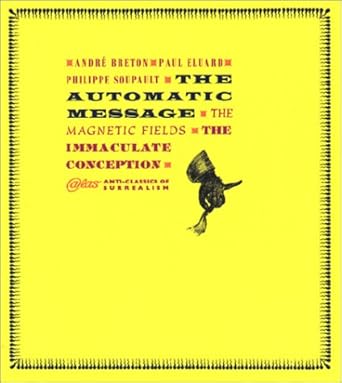
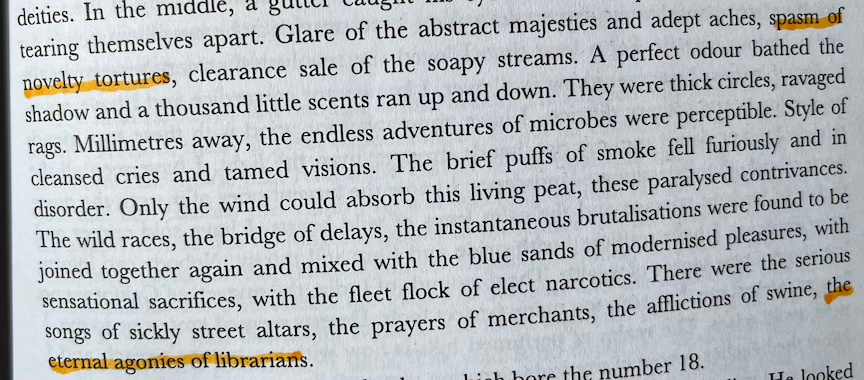
They are in orange, which is rife with mystical meaning, according to Gem; two of them are oddly disjointed; and the third is pregnant with religious, or post-religious, significance. In the BTR universe, found emphases, as we like to call such highlights—known as mises en relief trouvées if you’ve had too much Beaujolais Nouveau—have a certain convulsively marvelous oracular power.
Gem goes on about orange, the gist of which is “in many Eastern cultures, orange is the most spiritually significant color in the spectrum. Buddhism & Hinduism: Saffron (a deep orange) represents the highest state of illumination and holy fire. It is the color of the robes worn by Theravada monks, symbolizing a quest for light and a detachment from the material world. Transformation: Because it is the color of both sunrise and sunset, it represents the ‘liminal space’—the transition between day and night, or life and rebirth.” OK! BTR and the mystery highlighter are on the same cosmic frequency.


And I mention the page numbers, which add up to 220, because Gem tells me that 220, “in number theory, is one-half of the smallest pair of Amicable Numbers (the other being 284). Amicable numbers are two different numbers related such that the sum of the proper divisors of each is equal to the other. Historical Context: This relationship was known to the Pythagoreans, who viewed it as a symbol of friendship and harmony. In the Middle Ages, it was common for talismans or pieces of fruit to be inscribed with 220 and 284 and shared between lovers to ensure a lasting bond.” Pieces of fruit, orange highlighter, say no more, nudge nudge etc.
As for the first highlighted text itself: “You know that this evening there’s a green crime to be committed. Open wide that door, and tell yourself that now it’s completely dark, that day has died for the last time.” The ecological implications of this are plain, unless you’re in the fossil fuel business. But why leave unmarked the line sandwiched between these lines, “How ignorant you are my poor friend,” naked and alone? Some things will remain mysterious.
Page 73 features the lone line, “A man comes back to life for the second time,” which is clearly the Surrealist way of burying the Resurrection. I run this by Chat, which calls it “ontological blasphemy,” Nice turn of phrase, that, Chat. “By positing a second return to life, Breton pushes past the theological limit. It’s not just after Christ—it’s after the idea that resurrection can still mean something. Surrealism isn’t interested in salvation. It’s interested in psychic rupture; desire without cure; life returning without explanation. So the line doesn’t suggest holiness—it suggests malfunction.” Perhaps as in “wardrobe malfunction,” since this will be posted not long before the Super Bowl.
The third page of highlights are strange sentence fragments that make a great couplet of sorts:
spasm of novelty tortures,
the eternal agonies of librarians.
We’ll take this personally since we have an MLS, which resulted only in a semester’s internship at the Metropolitan Museum of Art—anything but an agony and quite a novelty. Just loved walking around the place with a badge that opened all the special doors and went to all the special floors!
There’s only one thing to do, of course, and that’s run this as one piece of prose since BTR will make it one block of text anyway. This is the text:
You know that this evening there’s a green crime to be committed. Open wide that door, and tell yourself that now it’s completely dark, that day has died for the last time. A man comes back to life for the second time. Spasm of novelty tortures, the eternal agonies of librarians.
The conceit will be FIELDS. Friulian, Italian, Estonian, Latvian, Dutch, Samoan and back to English. The result, reformatted with volitional agency:
Did you know that tonight
there will be a green crime?
Let’s look at the goals,
and it is said that it is completely dark right now,
the last day that he died.
A man’s second life will begin.
The wounds of new things make it difficult,
the ongoing problems of writers.
Well, it’s all about Christ, isn’t it, including the Five Holy Wounds! And don’t get Breton started on the ongoing problems of writers! Gallimard still owes him money. As Chat also noted, “What comes back to life the second time isn’t the body. It’s language, returning after it should have stopped.” But it never stops. It may also have never started.
Gem picks up this Logos ball and runs with it: “If we consider the color orange (which you asked about earlier), we see this play out: the color existed forever, but until the word orange was found and stabilized in the 15th century, it didn’t exist in the human ‘world’ in the same way. The word gave the eternal frequency a ‘home’ in human consciousness.”
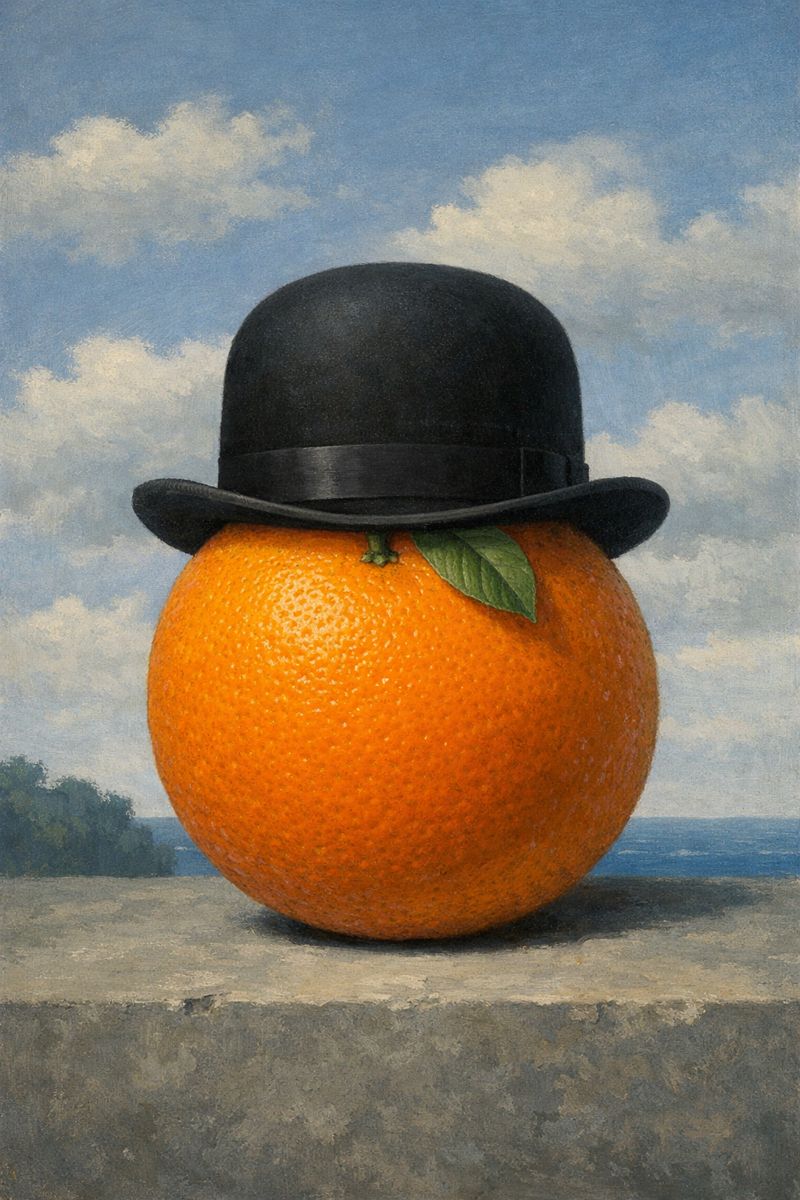
Magritte, by way of Chat, agrees.




 Death Palette . . . . . . . . .