
“In Further Magnetic Transference”: Cecil Taylor’s Last Poetic Bandstand
Leave a commentFebruary 14, 2026 by tsk2001
The Whitney Museum was an unlikely venue for what turned out to be Cecil Taylor’s last-ever gig, but there you have it. April 23, 2016, was the date, the concert serving as the culmination of the Whitney’s tremendous Open Plan: Cecil Taylor exhibition. Though the frail, 87-year-old Taylor had to be carefully helped to the piano, he seemed otherwise reasonably vigorous, and I wasn’t focused on the fact that, hey, I’m possibly attending his final concert. I made a pretty bad surreptitious recording of the proceedings, which I never listened to more than once because it’s, well, pretty bad. But a few weeks ago, FSR, a Polish label, released Words and Music: The Last Bandstand, which brought the experience roaring back into the moment with supremely better sound than the gig itself. One would not expect great concert sound in the sprawling Whitney gallery, and one did not get it. As for Taylor’s poetics, which are featured on more than half the concert, they’re difficult to discern under much better circumstances than the Whitney event. I’d seen Taylor a number of times previously, and there was never any aural clarity to his words—he seemingly was unable or unwilling to use a mic to his advantage.
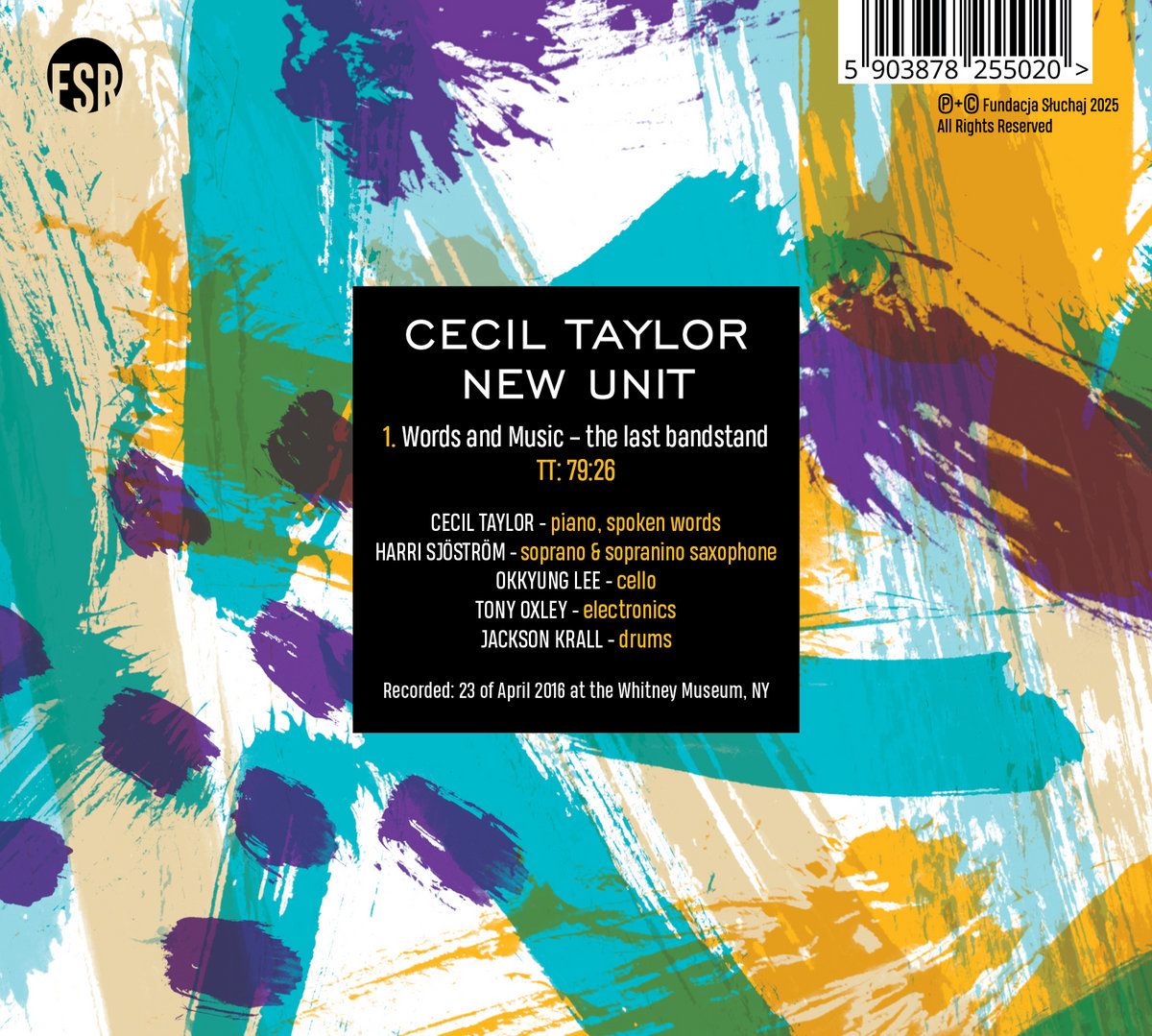
But now, thanks to this release, Taylor’s final poetic excursion is available with an unusual degree of coherence. Something must be done with this! I ask Chat if it can transcribe the text via an uploaded AAC file, making clear that I own the file—I’m already familiar with Chat’s copyright paranoia. It claimed it could, since I owned the file, but it actually couldn’t without additional tech. It started going on about the need for Whisper or some other transcription app, so I turned to Gem, suggesting it could give me just the first few minutes of transcription since it was a long file. I was fearing the same runaround I got from Chat, but Gem just took the damn file in short sections and spit out a no-hassle transcription of what it claims is the whole thing. Perhaps I should’ve tried the “thinking” version of Chat 5.2, but never mind, I had what I wanted. There may be some bungled words or phrases here and there—Taylor was notably bad at projecting his voice even when he’s using, or misusing, a mic—but we will consider the Gem text as the AI-enhanced Taylor text. First thought, best thought, more or less. Which is to say, I’m not comparing Gem’s text to the recording itself. It is what it is—a phrase, according to Chat (so it won’t feel left out), which philosophically “functions as a statement of resignation, realism, or stoic acceptance.” Or a simple shortcut.
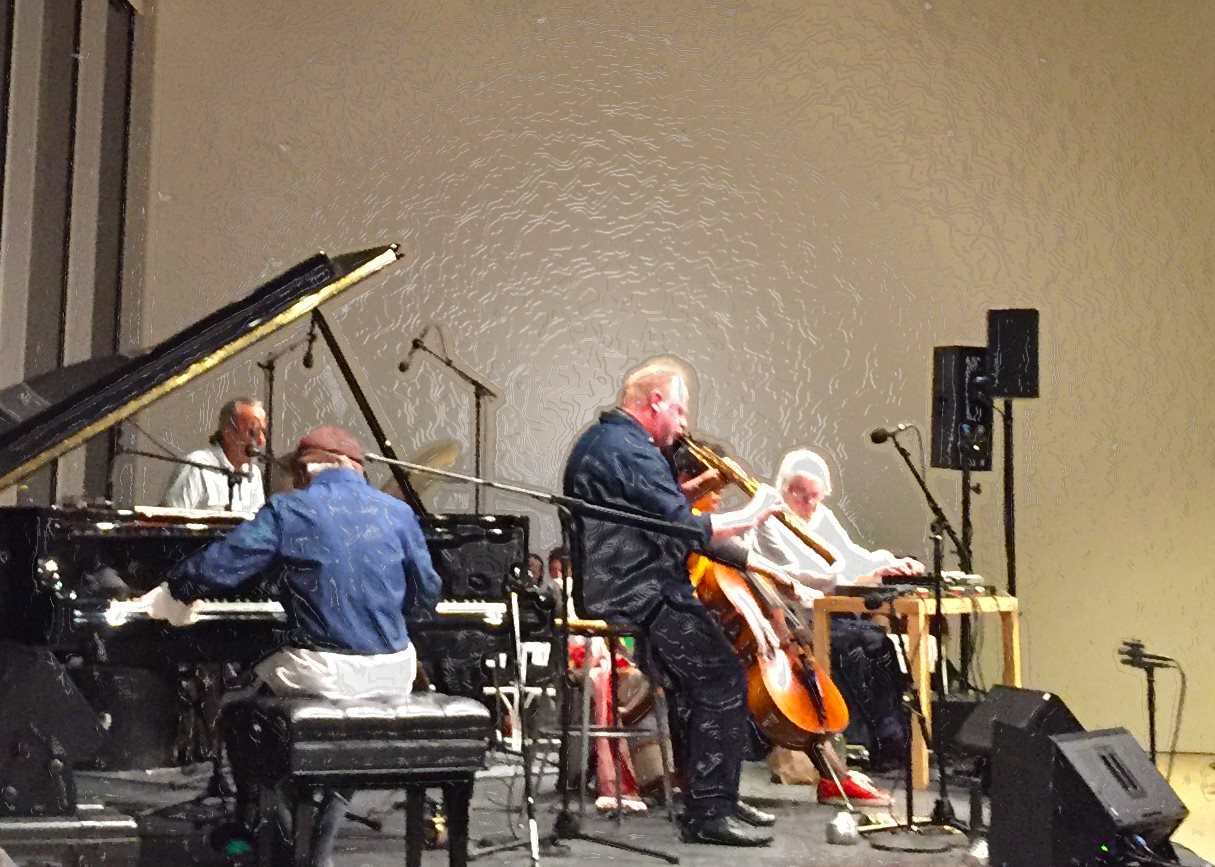
The sound was about as good as this image.
Moreover, I’m pulling select lines from the transcription. Taylor does a lot of rhythmic repetition in his poetry, in addition to spelling out various words with a mantra-like fixation, which I think is best left on the cutting room floor for the purposes of BTR—and where else would I be going with this but BTR? Bing Translate remains, in this age of super-digital translation, pretty much the same clanking piece of Rube Goldbergian, hit-or-miss sibylline wonder that it was in the early days of Bingian Thingianism. Or so we’d like to believe. We’re not putting it to the test, thank you. Never be pettish with a fetish. At any rate, here’s the text we have chosen, which, according to Gem, is from the first four minutes of track 2’s extended poetics. “Taylor’s poetry often utilized scientific and architectural terminology to create rhythmic, abstract structures that mirrored his piano playing,” Gem helpfully notes, having added explanatory asides to the text of its own accord. Indeed, as poet and scholar David Grundy explains in his Streams of Expression blog, “Taylor’s poetry is almost never focused on a lyric . . . but on history, mythology, broad and vast registers from science, space, the spirit in matter and matter in the spirit—the intangible records of tangible history, the broken continuum . . .” Further breaking the continuum, the repetitions have been removed and some punctuation has been added:
“The augmented registration and telluric regular cycles of motion in further magnetic transference in accordance with the telepathic storage of the commensurate vibrations originating from fractionalized injections. The organomic vitality stimulating seeds to germinate in a cabalistic procession inherent in the collision of the talus, descending orchestration of fluidic angular constructs. A transport gradual in its release of forces which accumulate systemically, engineering between the obelisk truncheon’s weight in contrast to the circular fields of syntactical drafts of the radius and its perimeters; therefore a view of structural alignment. Before the cell divides into insonic patterns of pulse silence possessed of its own terrakinesis.”
Terrakinesis is in fact a word, and so is organomics, though insonic may not be, but if it’s Gem “mishearing,” that’s fine. It’s always good to bring a little hallucinatory bud to the party. And the BTR conceit here will not be based on the usual keyword. In a tip of the hat to Taylor’s profound interest in West African history and culture, solely West African languages will be utilized, to wit: Hausa, Igbo, Yoruba, and that’s about it for West African languages on Bing Translate, so on the advice of Chat, I’m going elsewhere to include Swahili and Lingala. This is unfortunate in one sense, but on the other hand, Bing Translate as an inadequate and largely antiquated tool is exactly why we love it.
So let’s get to the output. Well, let’s not. The output is no more than a faint variation on the input. Perhaps this is a reflection of Taylor’s close connection to Mother Africa, but that’s clearly a stretch in the Bingian context. What if we filter it again, adding the five non-English European languages that represent the depredations of colonialism: French, Portuguese, German, Italian and Spanish (as chosen by Chat). Virtually nothing changes. This particular block of Taylor’s text seems immune to the machinations of BTR. We can run another block of text through other languages, but this being Valentine’s Day, we have another idea. Hey, Gem: would you mind writing a poem about love in the manner of Cecil Taylor, in honor of the day? Gem steps right up with its own peculiar spatial arrangement.
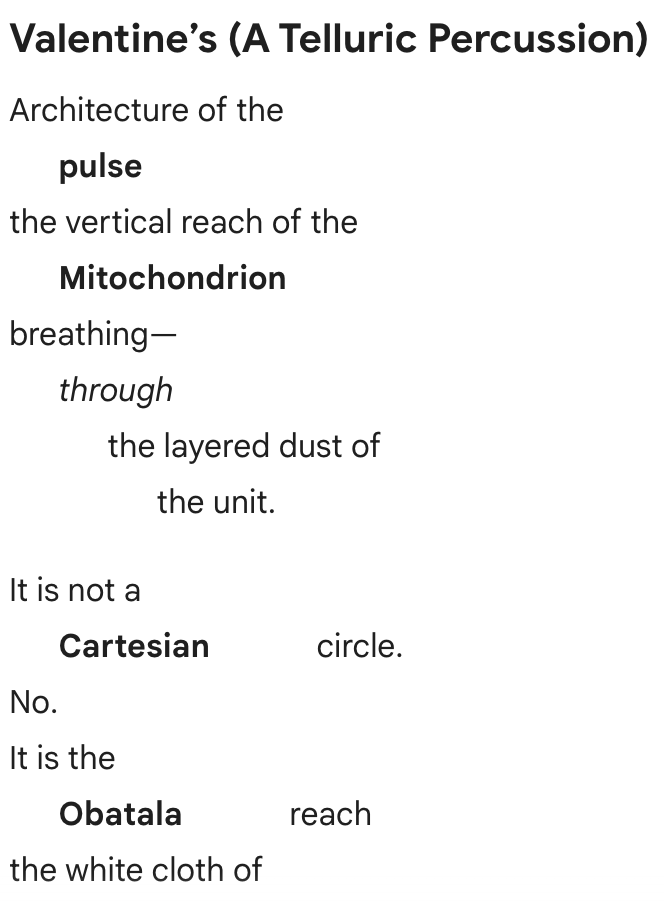
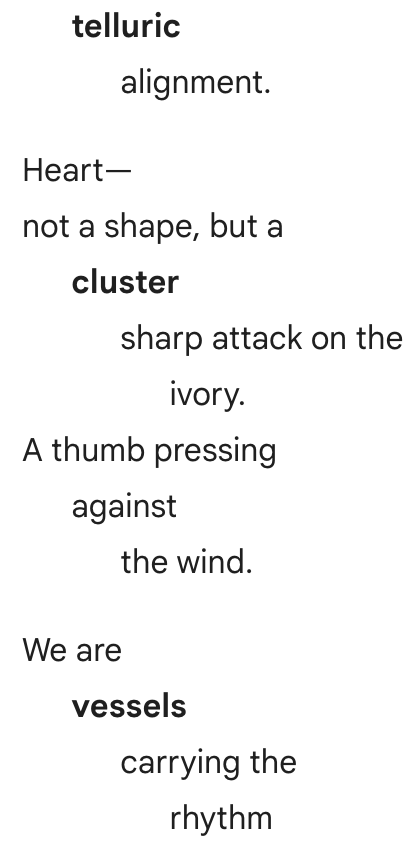
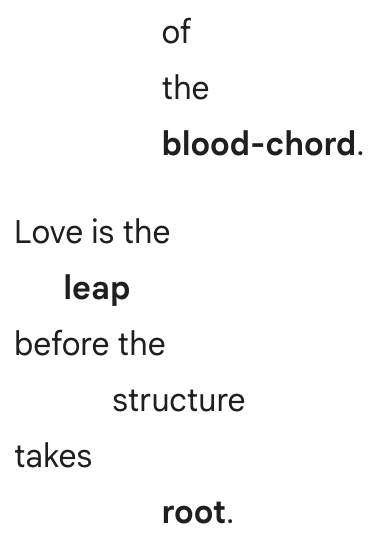
This could be a post-Singularity Hallmark card. Whatever it is, we like it. And we’re not running it through BTR. The structure has already taken root.




 Death Palette . . . . . . . . .