
Reconfiguring Breton’s “Free Union”: In the Ear of the Behearer
2August 16, 2025 by tsk2001
Is André Breton’s list poem, “Free Union,” the French precursor of Ginsberg’s “Howl”? Well, no, or perhaps it is, but the question is mainly a segue to Ginsberg writing about “Free Union” on the Allen Ginsberg Project, where he notes that Breton’s poetry is “a bit wooden and his prose arid . . . There’s a funny tone that he’s got of imperious insistent proclamation and manifesto stubbornness . . . ” At the same time, “there is one great poem by Breton, which is the singular seminal ‘list poem’ of the twentieth-century, which many people have read, and many people have imitated . . . His list is about his wife, which should be a serious subject and should, presumably, evoke all sorts of nostalgic and sentimental, or romantic, faithful, or sincere improvisations, but what you get is a real twentieth-century dissonance and absolute reliance on the unconscious.”
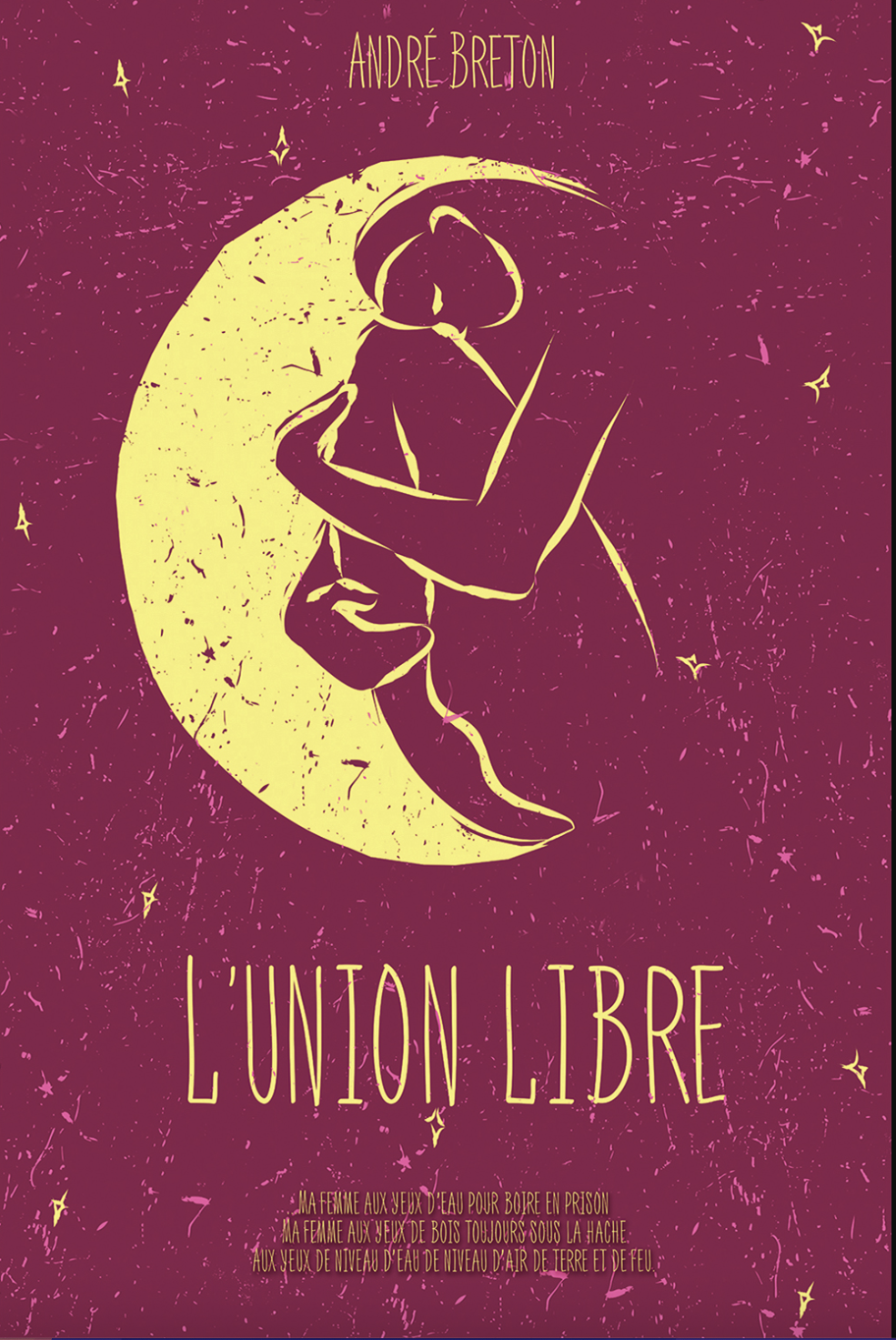
We don’t see why a list poem about one’s wife is necessarily a serious subject, and Breton was not exactly Mr. Faithful—the wife in question here is the long-suffering Simone Kahn, who was married to Breton from 1921 to 1931—but never mind, enough intro. You will find the French original and an English translation on the afore-linked Ginsberg page, but we’re gonna take an English translation by David Antin, who among many claims to fame was a mentor to Kathy Acker, whose spirit infuses Death Palette in certain ways—all things interpenetrate with DP, it’s about everything, like a Mahler symphony (no, really), and we’re gonna run it through BTR via a Cageian acronymic sort of semi-chance operation: Take the letters of the English title of the poem (FREEUNION) and choose languages that begin with that letter. So we get French (very conveniently), Russian, Estonian, Esperanto, Urdu, Norwegian, Icelandic, Odia, Nepali, and back to English, of course.
Odia? you may ask. It’s “a classical Indo-Aryan language spoken in the Indian state of Odisha.” Its frequently jellyfish-like script is stunningly exotic upon first sight, and it’s only one of two “O” languages in Bing Translate, the other being Occitan, and we’ll get to that another time, this appearance of Odia being somewhat volitional, but what the hell (and Bing Translate was frequently flummoxed by Odia, able to parse it only in very small doses). Others here may have been somewhat volitional too, but this is not Cage throwing the I Ching while laughing and identifying mushrooms, all right?

Now to the poem. It has an oddly long title, which is curiously ironic since Breton, who made no secret of his disdain for music, “simply had no musical sense: despite the rhythm that infused his writing and recitations, he couldn’t tell Satie from Satchmo,” as Mark Polizzotti notes in his brilliant Breton bio.
My Ear’s Path is Like a Free Relationship
Hair compared to fragrant flowers
Thoughts as warm as a bath
A land of copper in the middle like a clock
Where one has to stand to gain the honor of a sun
A choice like that below and hands of a colored shield
The vision of a lion’s teeth
The color and fragrance of flowers that must have a significance
As water is like paint enclosed in a long and exquisite index
With decorative curls where the grass is placed
My serpent if their best songs are childhood stories
Then the birds are their cave in the mountains
My serpent if their transitional poetry is the dust hanging in the path of growth
My serpent if their shoulder is the nectar
They are the enclosed letters on fish that connect with dolphins
My serpent if their writing is a war
If their ring is a ticket to a game of hiding
Which is played under the red umbrella in spring
if their ring is a twig of a new botanical creature
My serpent if their hands are holding soft silk and flowers
Yes in the summer light there is an unbroken umbrella of life and fish
Where their hands are shaped by the sea and
They are sitting in the ocean deep mingling with the waves
Where their feet are stirring on the horizon with heroic movements and despair
My wife where her choice must have a sweet black syrup
Where her feet begin to be depicted in clay
Her feet creating the main feature and the umbrella
My wife where her neck is in the shape of fragrant onions
My speech which boasts the seriousness of the Lord
And merges into the embrace of trials
My speech whose movement is between the cyclical vehicle
And the dark sea of night
My speech whose movement captures the creation
Of a crocodile in the mouth of a ruby
Where the sun opens in front there are great storms
My speech which is adorned with numerical decorations
And in bright ornaments there lies even the art of Seimaiki Paskun
My speech whose throat carries hateful verses
In a golden character reveals the ancient loose faith
And openly leads with the mental thorns
Of traditional insights in the attire of the evening
My speech which in looking at the surface of the water
Only begins in the method of being banked across the sea
It appears that it has been refined by a material
Of subtle clear metal like a flower or like an arrow
And on an unknown plane
My girlfriend if they have a treasure of wealth and cotton
If their wealth is a shovel and spring
My girlfriend is pregnant of face and lotus and clarity
If their union prefers a path of black and ancient light
My girlfriend will become a burning union
My girlfriend if they have eyes
The eyes are filled with tears
Eyes that look like the windows of a lake and magnetic nails
Eyes that scream
Eyes that are filled with water from the gaps
My beloved’s eyes that are like the forest
Always swaying beneath the flag
My beloved’s eyes that are like water air earth and fire

Breton had a lot of dolls, just as he does in this poem. His wife is a serpent before she’s a wife, then she’s his speech, his girlfriend and, finally, his beloved. Just a couple of notes: Lineation is quite deliberate and patterned after the original—Bing Translate produces a solid block of text. The obscure Seimaiki Paskun, we conclude, is a nugget of Duchampian wonder. Paskun is seemingly Lithuanian but does not directly translate. It’s likely etymological dross. The art of Seimaiki, on the other hand, is plainly Japanese, meaning “rice polishing machine.” The echoes of The Large Glass and the Chocolate Grinder are palpable. “It has been refined by a material of subtle clear metal like a flower or like an arrow,” you might say.


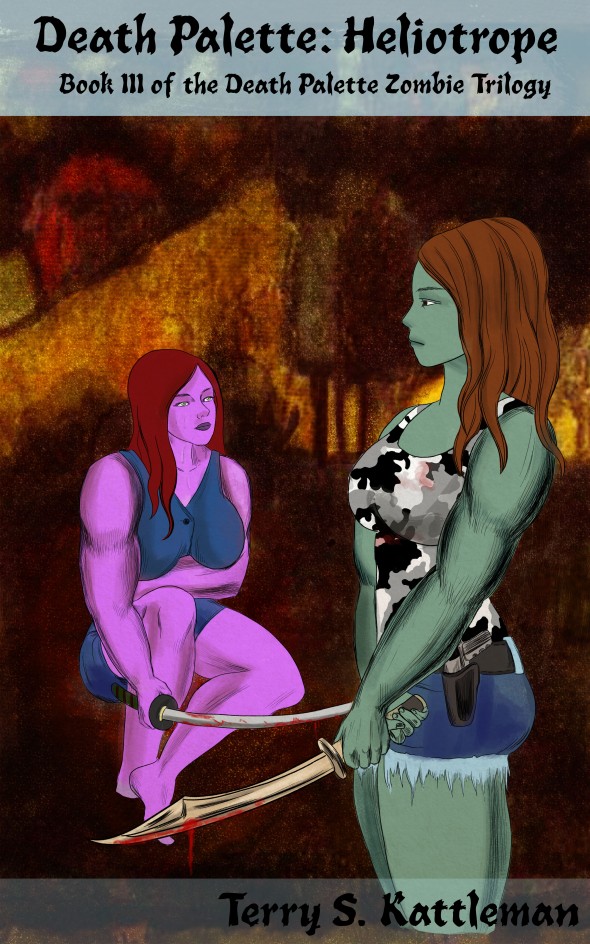


 Death Palette . . . . . . . . .
The Ear of the Behearer is a 1973 album by Dewey Redman, the “free jazz” saxophonist. The first track on this record is titled “Interconnection.”
His wife may have been Simone Kahn but the poem was written for his lover, Suzanne Muzard. Typical, no?