Duchamp’s “THE”: Derisking the Asterisk
Leave a commentJuly 15, 2026 by tsk2001
So I finally got to the big Duchamp show at MoMA, and as I wandered around, noting the many handwritten notes in French on display, I wondered if there was anything in English that could be run through BTR. And there was! I photographed it, somehow forgetting in my hallucinatory excitement to seek out the label, and when I sorted through the pics later I had no idea what it was. I checked the MoMA exhibition catalog online and couldn’t find it. It was, at this point, the Duchamp Mystery Text.

I transcribed the text (below) and popped it into Chat and Gem just to see what they’d make of it.
“The
If you come into linen, your time is thirsty because ink saw some wood intelligent enough to get giddiness from a sister. However, even it should be smilable to shut hair whose water writes always plural, they have avoided frequency, meaning mother in law, powder will take a chance; and road could try. But after somebody brought any multiplication as soon as stamp was out, a great many cords refused to go through. Around wire’s people, who will be able to sweeten rug, that is to say why must every patents look for a wife? Pushing four dangers near listening-place, vacation had not dug absolutely nor this likeness has eaten.”
They didn’t ID it as a work from the show, or as anything in particular. Gem says, “This looks like a classic word salad or an AI-generated surrealist text designed to sound like a coherent grammatical structure while completely throwing logic out the window. It reads a bit like a Dadaist poem or an old-school cryptography puzzle!”
Chat says, “This reads like a machine-generated text in the style of a surrealist or ‘random substitution’ exercise. It has enough grammatical scaffolding to suggest meaning, but the semantic connections are continually broken.” They say a lot more, of course, they do love to go on, bullets flying, but it’s Chat who offers, “If you wrote this intentionally, I’d describe it as a successful example of semantic destabilization,” making Chat the bigger flatterer here, and I gotta love that “semantic destabilization,” which seems to be the default for most forms of discourse these days, so I tell Chat the truth first and upload the photo.
But I do the same for Gem; they have different personalities and they could offer very diverging replies, but they both ID it immediately, and to quickly dispense with the details, it’s the handwritten earlier version of what became a typed piece, titled “The,” or “Manuscript for ‘The,’ ” from October, 1915, ink and pencil on paper, and it’s on loan from Philly, as you might expect.
Duchamp replaced all appearances of “the” with asterisks (five-pointed stars) in an “incredibly exhausting” effort, as Gem puts it, “to create a painful exercise in anti-meaning. His goal was to construct a paragraph that was 100% grammatically flawless, yet completely devoid of logic, narrative, or sensory relation to the real world.”
Gem goes on to note, “Despite his best efforts to erase meaning, art historians have pointed out that his subconscious still sneaked through. For instance, the phrase “ink saw some wood intelligent enough to get giddiness” is widely believed to be an accidental, playful nod to his close friend and fellow Dada figure, Beatrice Wood.” Well, I take Ms. Wood’s autobiography, I Shock Myself, off the shelf, (skimmed it, never read it, plenty of pictures) and pore through it for the “The,” which is nowhere to be found. Nor does it appear in 3 New York Dadas (same deal, a skim with plenty of pics), which I also pore over, trying to get some use out of books from my long-ago collecting mania, which sit on gruff bookcases in stolid mockery now that I can barely bring myself to read anything that’s not on a screen.
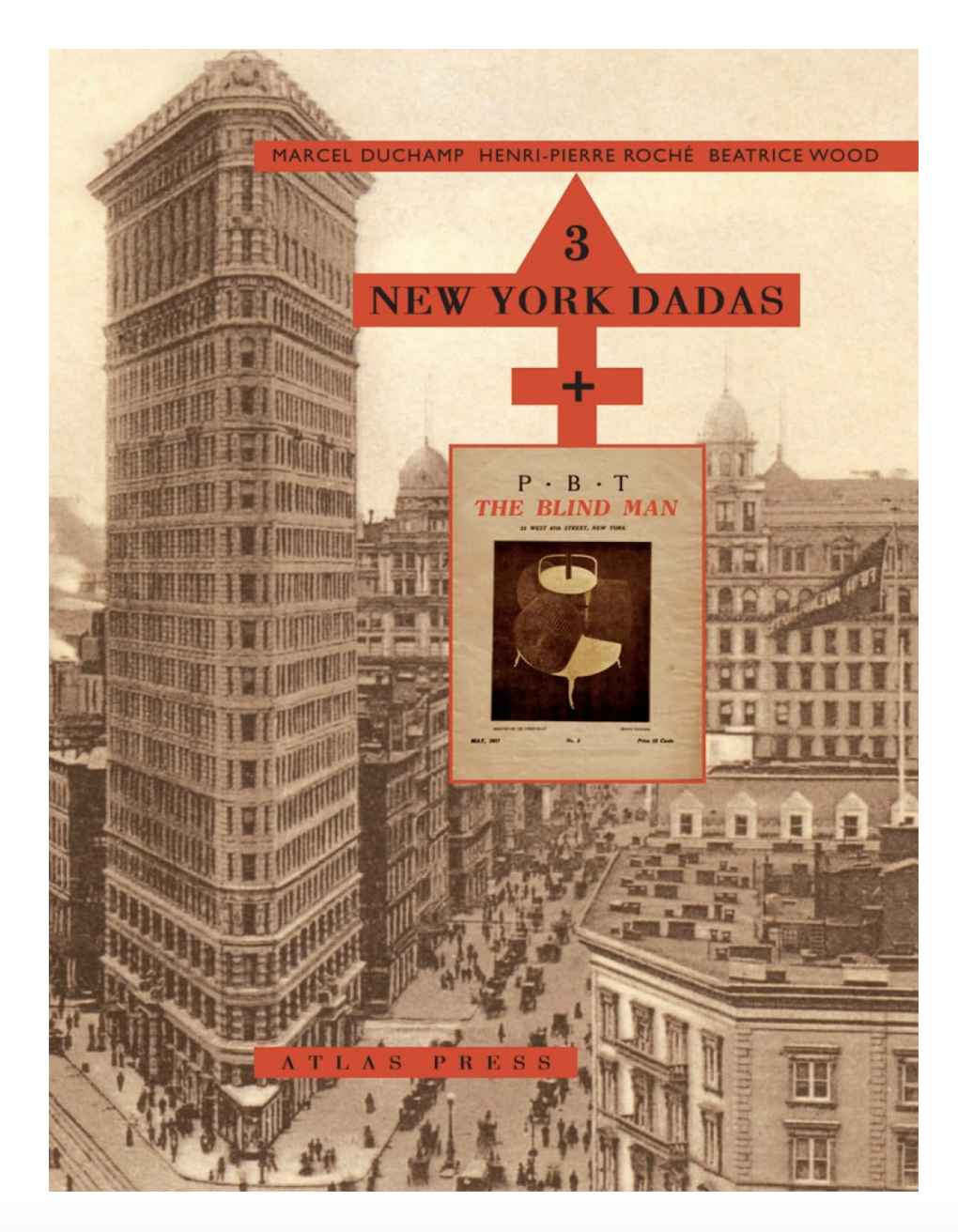
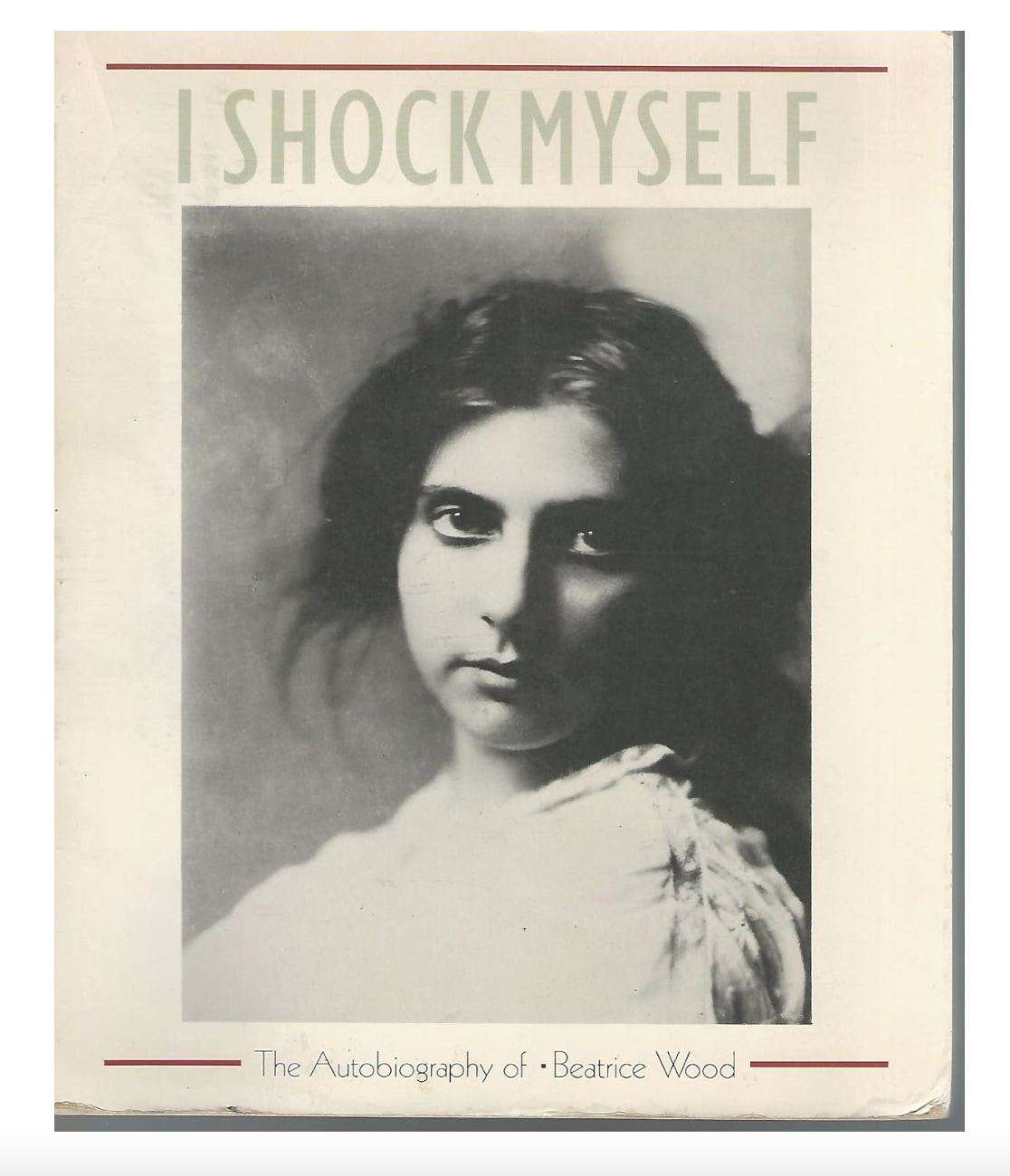
At any rate, I run the text (sans asterisks) through BTR via a Euro-heavy MARCEL conceit (Maltese, Azerbaijani, Romanian, Catalan, Estonian, Lombard), which yields this:
“If you go straight, your time is tight, because the water has found the wood that was smart enough to tire itself out in its own home. Anyway, even if it has to tie its hair, the water always writes together, the frequency has escaped, what the grandparents say, a random beat remains; and the foot can try. But if what it carries multiplies as if it were out of shape, it’s afraid to go through so many ropes. Around human heads, the thing that can disturb the wind, I mean, because they have to have all the patents, does it find a woman? Towards the listening place, taking a few risks, the vacation wasn’t perfect and it seemed like the food wasn’t eaten.”
The first thing to be noted is the fact that BTR has somehow restored, or materialized, no fewer than ten definite articles. The next thing to note is the fact that the final sentence, “Towards the listening place, taking a few risks, the vacation wasn’t perfect and it seemed like the food wasn’t eaten,” is painfully coherent, probably even to Beatrice Wood, were she still with us. I’ve been on that vacation: the one where you wear noise-canceling headphones much of the time, complain endlessly about how the food sucks, and you can’t wait for this to be over. It might’ve been on a cruise, or at a resort, or both. I might further note that, “Around human heads, the thing that can disturb the wind, I mean, because they have to have all the patents, does it find a woman?” sounds suspiciously like a concise summation of “The Large Glass.”
Moving on, I ask Chat and Gem to take this BTR’d text (not explaining where it originated, of course) and present it as Duchamp’s handwritten work, complete with asterisks. That’s it, not getting all antsy about the specificity of the prompt. Chat does not do too well with this, apparently tossing it off from the back row of its mind in a millisecond.
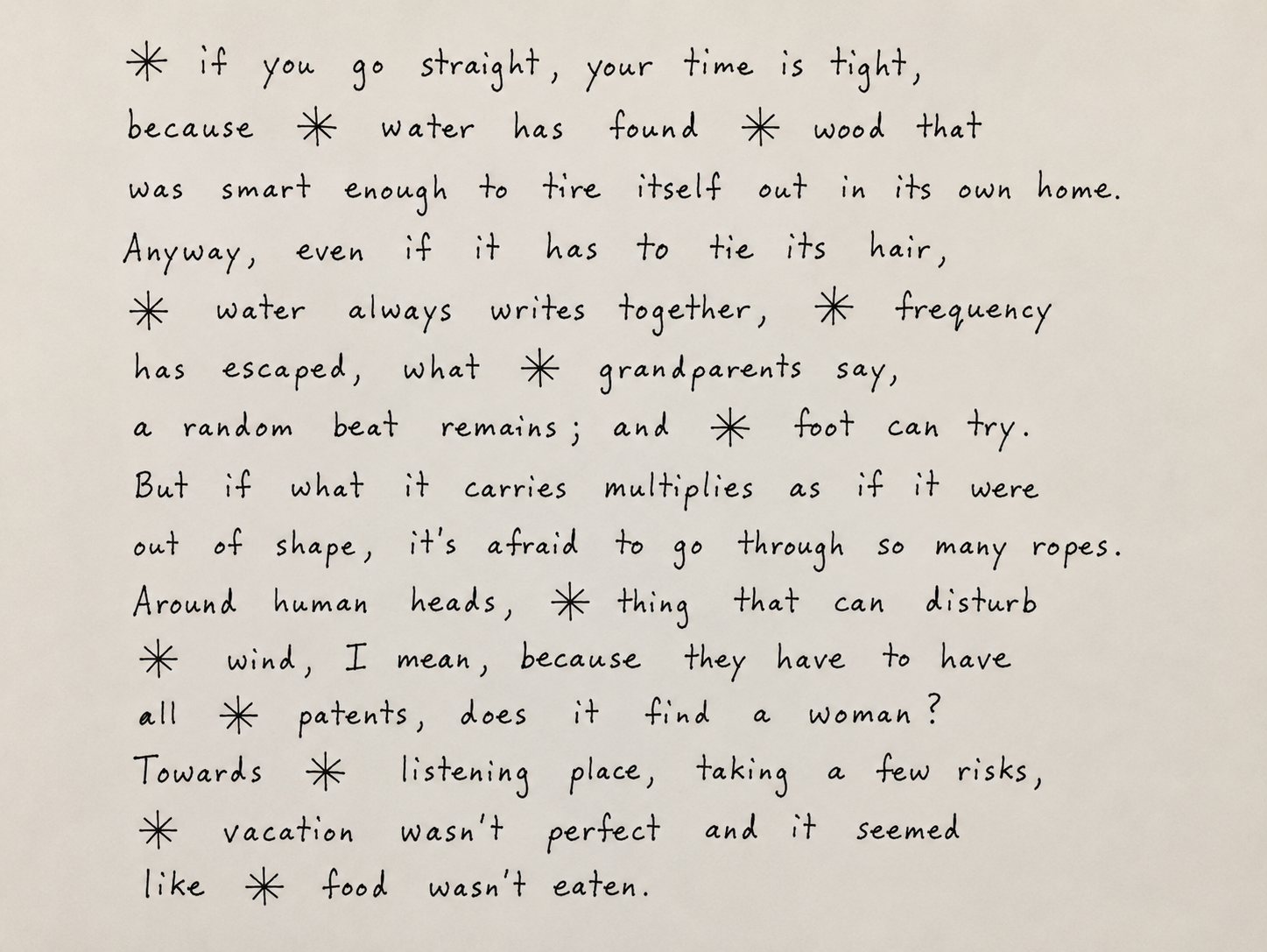
Gem does more than a bit better, actually putting the work in a frame, including the remplacer chaque [étoile] par le mot: the (‘replace each [star] with the word: the),” with a snippet of label to the side as if it were in the show.

In an interview, Duchamp referred to “readymade intent,” possibly in connection with the unexpected breakage of “The Large Glass”; I can’t recall exactly. The point is, * BTR text is that: * break with * past that doesn’t so much erase meaning as subject it to a sort of Rauschenbergian palimpsest treatment. After all, * frequency has escaped what * grandparents say: a random beat remains.