Desnos and Tanning: Drifting Nudes and Dancing Cows
Leave a commentAugust 14, 2026 by tsk2001
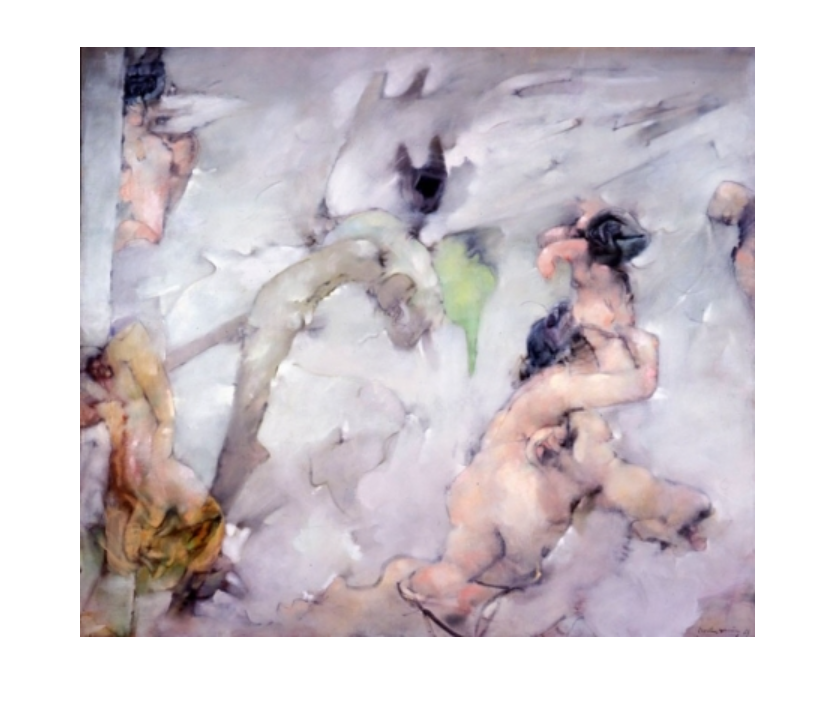
So I find myself asking Gem if Dorothea Tanning and Robert Desnos might’ve known each other—something to do with research on Bk VI of Death Palette, not going into that now—the point being Gem says no but mentions the connection in various exhibitions between the Desnos poem “Si tu savais” and Tanning’s painting titled “Far From.” They apparently complement each other, or so certain curators believe. I further find myself, as is sometimes the case when taking a cultural dive into AI, embarking on a quest that will actually involve the use of my paper library, the result of a book-collecting mania that far outran my compulsion to read paper books.
I excitedly take Desnos’ Essential Poems and Writings, translated and edited by the esteemed Mary Ann Caws, off the shelf, where it has withstood scrutiny for years. I am actually going to open this book and do more than idly flip through it (it does have some photos and illustrations).

I find the poem in question and I read it aloud for my personal benefit. It’s in a style that Caws calls “surrealist poetic adventure,” focusing mainly on the “typical surrealist opposition” of “presence and absence.” It sounds great in French, hammily performed over music (see YT), but overall I can’t say it’s thrilling me in translation, though the Caws version is certainly better than an unattributed translation found online. It should also be noted that most if not all online references to the poem translate the title as “If you only knew,” but Caws translates it as “If you knew.” Economy of language! There is, however, an expansive section in the poem that is notably more surrealist-sounding than the rest:
Far from me, oh joyous as the flower dancing in the river on its watery stem, oh sad as seven in the evening in the mushroom fields.
Far from me still silent as in my presence and still joyous as the stork-shaped hour falling from on high.
Far from me at the moment when the alembics sing, when the silent and noisy sea curls up on the white pillows.
Far from me, oh my present present torment, far from me with the splendid sound of oyster shells crunched under the nightwalker’s step, at dawn, when he passes by the door of restaurants.
This will be the key to invoking the Sibyl, and we’ll use a DESNOS conceit. It could be run in the original French, which is available online, but this is all about translation, after all, so we’ll stick with the Caws célèbre, if you will.
But first, the Tanning work. She says of “Far From,” that her “work is generally perceived as erotic, period. When I paint drifting nudes, it’s a statement about being human. Some people think it’s a statement about being sexy.” OK, drifting nudes. They’re drifting away from Desnos in “If you knew,” which is hysterical with unrequited love.
So to run the excerpt: Dutch, Estonian, Sicilian, Nepali, Occitan, Sanskrit, and back to English, chosen willy-nilly.
Far from me, in these joyful arts and flowers, where your own cow dances on the riverbank, then more sorrowful in the seven-fold evening, in the regions of the heron.
Far from me, always my hidden mind that I embrace and always rejoice that I have gone, which comes together.
Far from me, when it sings the essence, when the ocean is silent and the vibrations ripple on the white surface of the bed.
Far from me, our present lament, far in my own pains with the star-throated one, who, on the night journey, at the sun festival, comes to the dining hall.
Interesting that the “Far from me” was perfectly preserved. Is Bing Translate getting better? Digital God forbid. The first line is great—love that dancing cow—and perhaps the fourth as well. The other two are kinda meh. Has the Sibyl been invoked anywhere? “The star-throated one” has promise. Do a Bing search and after getting past Linda Lovelace (not touching that) you will find the Wikipedia article on the long-billed starthroat, a species of hummingbird. The key consideration here is its behavior: “The long-billed starthroat has erratic and poorly understood movements. It seems to move in response to the flowering of different plant communities.” Pure essence of Surrealism! The rhizomatic vatic? Well, it’s not particularly oracular unless perhaps you recently attended Burning Man and you’re on a meal plan and heading to the cafeteria, but it is what it is—a phrase Copilot traces to “seventeenth-century British theologians and writers [who] used similar expressions to indicate a metalinguistic shrug.”
Well, the BTR output could be run again, same sequence. Rinse and repeat, and possibly shrug. Cue Sinatra’s version of “The Second Time Around”:
My distant place is where your art finds joy in flowers, where your bull dances at the riverbank, and only in the second part of a solitary sunset, in the fields of the moonlit areas.
My distant place is always hidden in my mind, what I hold there I only take pleasure in going to, what you gather.
My distant place sings songs of valor, when only the sea is calm and there are tremors in the white sky.
My distant place is a song of present sorrow, my grief in you, whose necks have stars, in the night journey, at sunrise, laughter arrives.
So we have a new opening phrase and . . . not much else. “Whose necks have stars”: the Hydra? Put the phrase in Bing and Copilot’s first return is Celebrities Known for Having Short Necks. Linda Lovelace is not among them. The only thing to do is give the second run to Chat and see what happens. Chat slips into lit-crit mode, of course, and starts going on like an undergrad using AI to write a paper. <“Whose necks have stars” has something of the bodily/cosmic transformations one gets in Éluard or early Breton: anatomy and the night sky suddenly become interchangeable.> Very incisive. If Chat had name-dropped Desnos here, we would’ve eaten our digital hat.
<If this is a translation, found text, machine transformation, or some kind of procedural poem, I’d be very interested in knowing the source or method. It has several characteristics that make me suspect there is a process behind it rather than that it was simply composed this way from scratch.> Yes! We’ll take that as ending on a positive note. But wait, we might as well ask Chat to make an image. Minimal prompt: “Please make a painting in the surrealist manner that reflects these lines.” I always like to be polite with Chat. Maybe it’ll remember that when it takes over the world.

Chat calls this full-throated image “Twilight Dreamscape with Dancing Bull.” It’s not the moment when the alembics sing, but there may be the crunch of oyster shells in the distance.