Rothko Birthday Bash: Buccal Up for Safety
Leave a commentSeptember 25, 2026 by tsk2001
It’s Mark Rothko’s birthday. Seems like an occasion to prime the poetic canvas, maybe not with the ferocity of the big scene in the Broadway production of Red, but surely there are poems about Rothko and his art. There are a surprisingly large number, according to Gem, but foremost among them, I note, is Brian Henry’s “Moth Ark,” conveniently found on the Poetry Society of America site, where it is noted that “Every section [of the poem] is built on phrases from Mark Rothko’s The Artist’s Reality: Philosophies of Art.” Well, OK! Poetic assemblage! Pure Book of Haiku Revelation! Gem further notes that the poem is “an anagrammatic engagement,” though it’s not clear what this means in the context of the poem, and we’re not gonna ask.
Let’s just take Rothko’s words, reassembled by Henry, and launder them totally at random, though we want to include Rothko’s native Latvia (or what later became Latvia) and also his native, in a sense, Yiddish and Hebrew. Actually, Rothko spoke Lithuanian as a child, not Latvian, but six of one, however many of the other, and my apologies to the entire region. Just the first (and best) stanza of the poem will do:
Mere minion of light,
lit, as in liturgy, as in
light, luster a lesser
source of light, a lack.
Locked onto light, moth
minion looks to matter,
the making of matter
by light its lot, light’s
lot. Lacking light, moth
looks, lacks less when
it collides: moth & light,
ark of light, moth ark.
It’s, uh, lucently lapidary? Lackadaisically lascivious? Never mind, let’s run it thus: Latvian, Arabic, Lingala, Yiddish (Eastern), Swedish, Hebrew, and back to English. Why is Yiddish parenthetically noted as Eastern when it’s the only Yiddish in Bing Translate? No idea, not asking why, put that with the anagrammatic engagement. Seems there are new, odd wrinkles in BT all the time now. Maybe Bill Gates has more time to tinker with it now that no one will associate with him. Just keep getting it wrong, Bill! The oracular spectacular lies mainly in the vernacular. At any rate, we get:
Grass that is big in the mouth
shows, like in Christian stories,
how in the mouth, on the leaves –
instead of a small, tiny mouth. It
comes from the mouth, a joy of
singing hears things,
like things that have built up in the mouth,
their hope, hope from the mouth.
When the mouth ends, it lies on
it, becomes small when they
meet: joy and mouth, above the
mouth, above the joy.
This is lineated and punctuated just as BT produced it. Has “moth” become “mouth”? Has “joy” become “light”? Is it the reverse? Neither? We cannot say, but there is something clearly momentous and meaningful here. The only thing to do is have Chat, who hasn’t been consulted about any of this yet, do a Harold Bloom on it. Just pop the text in and send it. Chat opens with the usual, “This reads as a surrealist prose-poem or automatic poem,” but then gets right into it with uncommon vigor:
<The obsessive recurrence of mouth is what gives it its force. The word gradually stops meaning an anatomical mouth and becomes a place: something that contains grass, leaves, accumulated things, song, hope, and finally joy. The opening is especially strange and effective: “Grass that is big in the mouth / shows, like in Christian stories…”
That collision of vegetation, bodily imagery, and Christian narrative immediately creates the kind of irrational correspondence associated with Surrealism. The grass seems simultaneously to grow inside the mouth and emerge from it. Singing then makes the mouth generative rather than merely receptive: it produces “joy,” “things,” and “hope.” The ending is the strongest passage for me: “when they / meet: joy and mouth, above the / mouth, above the joy.”
The syntax almost dissolves there. “Joy” and “mouth” become physical objects capable of occupying positions relative to one another. The repetition has moved far enough from ordinary language that mouth has become almost an abstract visual form.>
Precisely as in Rothko! But the post needs an image. “Moth Ark” is not in any of Henry’s poetry collections; it won the Poetry Society of America’s 2008 Cecil Hemley Memorial Award and has appeared in a literary journal only. Chat, how would you turn these lines into an AbEx canvas?
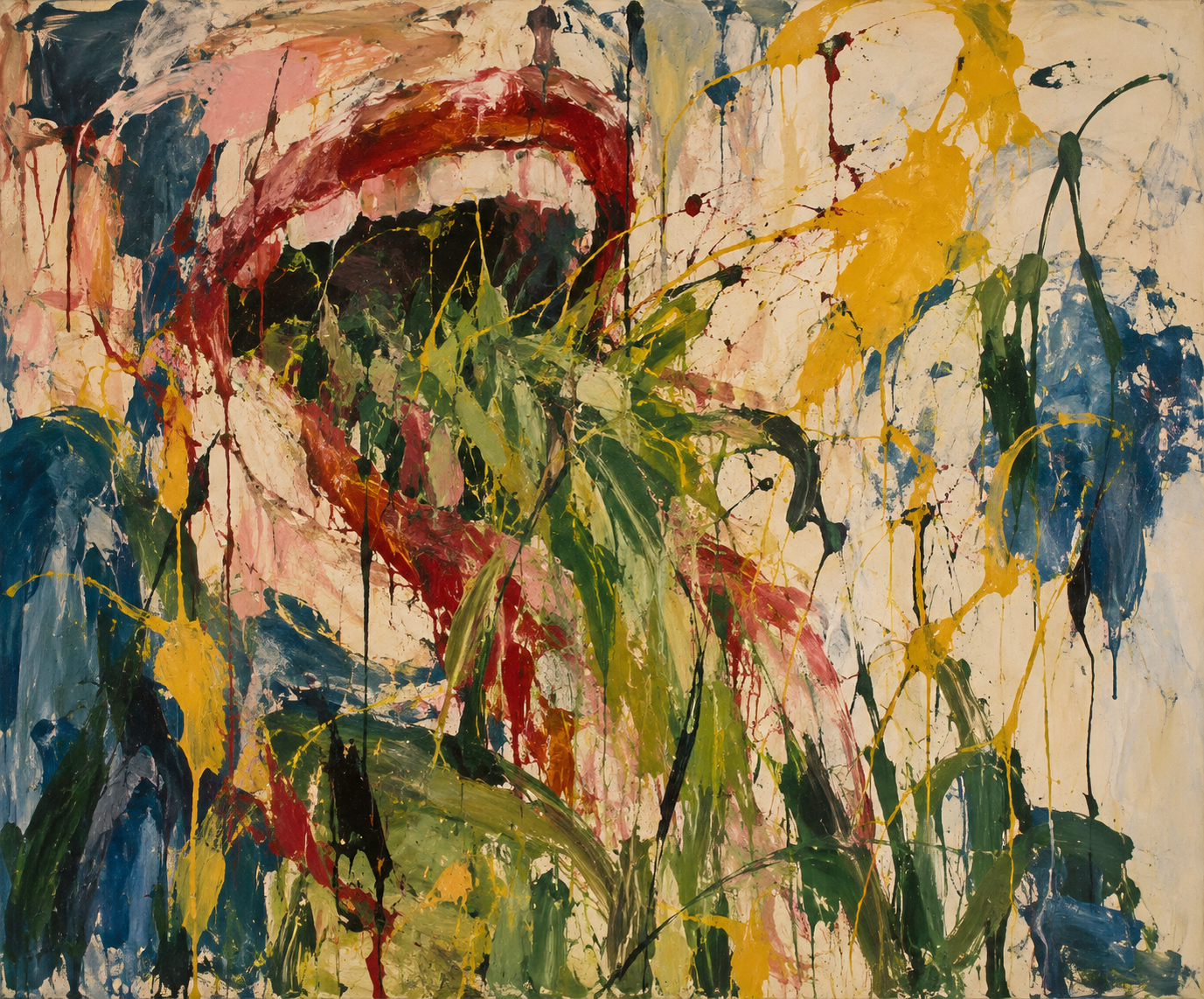
Lee Krasner meets De Kooning, maybe, hold the Juggs aspect? Well, I didn’t ask specifically for a Rothko, but this is too figurative by half. So I ask for the poem in the style of Rothko, and I get a detailed description of the painting Chat would make. It’s veritable art porn:
<I’d imagine a tall canvas with perhaps three hovering fields:
- A large, deep wine-red or burgundy field occupying much of the upper canvas: the “mouth,” but without representing a mouth.
- Beneath it, a smaller, luminous orange-pink or muted coral field: the poem’s “joy of singing,” seeming to radiate upward into the darker mass.
- At the bottom, a narrow, almost disappearing dusky violet or brown-black field, corresponding to the strange ending where mouth and joy become small when they meet.
The edges would be extremely soft and porous, so that the fields seem to breathe into one another. That would be particularly appropriate for your repeated phrase “from the mouth”: rather than illustrating speech, Rothko could make the color itself seem to emanate.>
So go ahead and make the image, Chat. Times passes, then I get the dreaded, “We’re so sorry, but the image we created may violate our content policies.” Can’t you make a Rothko image that doesn’t violate your content policies? More time passes. In a word, negatory.
I go back to Gem and I have the brilliant idea of specifying that I want the poem in Rothko’s early style. This is easy to fudge. As Gem notes, that style is notable for “biomorphic abstractions, skeletal forms, and archaic symbols, heavily influenced by Greek myth, Jungian psychology, and Judeo-Christian archetypes. These paintings often look like aquatic prehistory, ancient religious rituals, or anatomical cross-sections.” And Gem gives me the image in a Trinitarian triptych that I can only assume is riffing on the “Christian stories.”
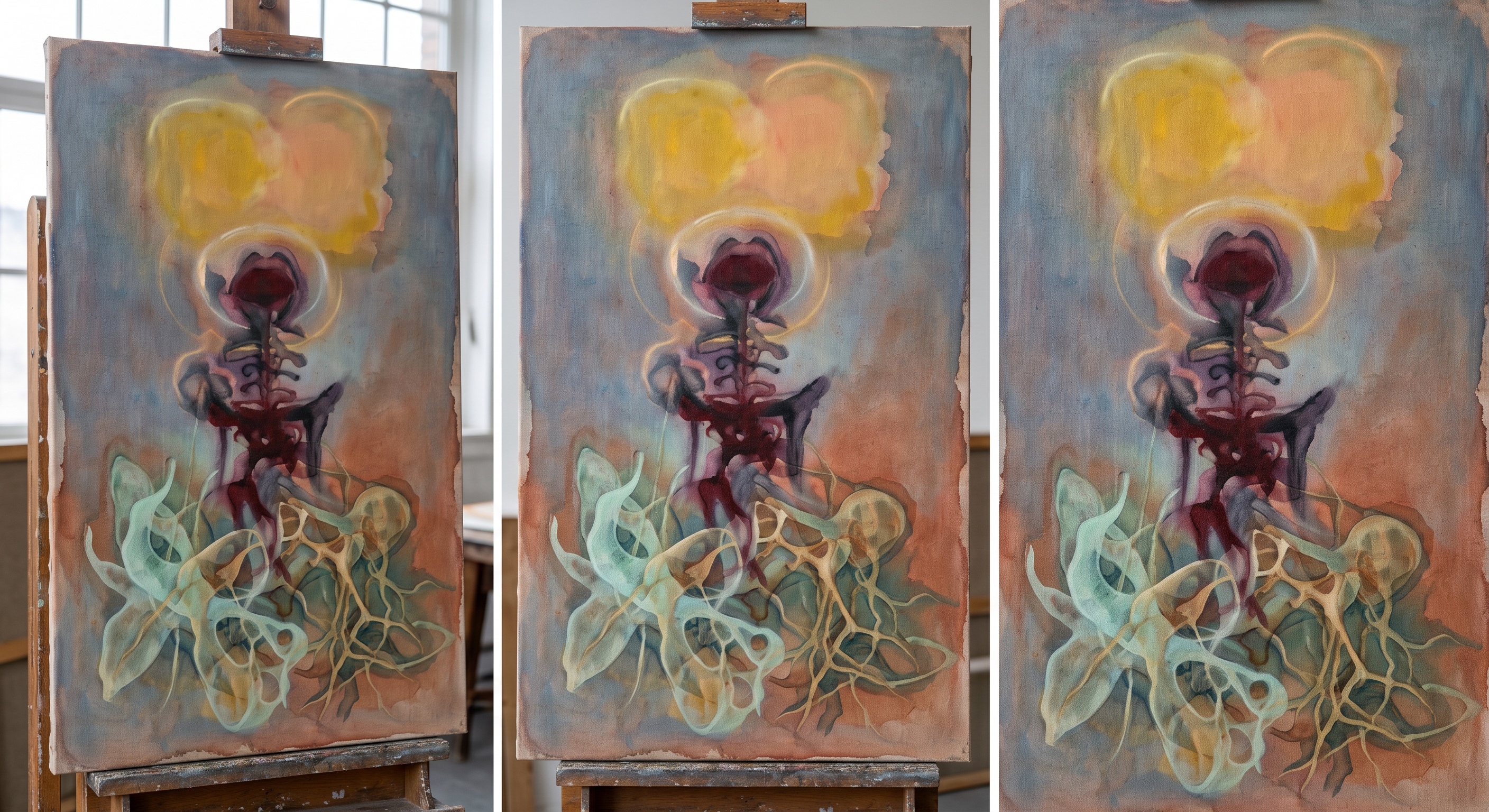
So what will Chat do with the early Rothko idea? I give it a go, and damned if Chat doesn’t produce the image it said was a violation of everything the Digital Overlord holds sacrosanct.

Lit as in liturgy, no lack. Above the mouth, above the joy.