MoMA “Surrealist Book” Show: The Canned Writing is on the Wall
Leave a commentOctober 14, 2026 by tsk2001
“Tomorrow Lives in Mirrors” is the theme of this exhibition, but today lives in the eight quotes that MoMA chose to put on the wall at various points around the space. Just run them together into one literary assemblage and filter accordingly. Or accordionly, since they’re gonna get squeezed. The MoMA online blurb notes: “Books, the Surrealists insisted, ‘are doors.’ Whoever ‘opens them is immediately thrown into a higher realm.’ ” So too the quotes, which are kinda high up the wall, somewhat difficult to photograph, and clearly do not make much of a visual impression, especially in these less than spectacular pics. But I’m not having Chat or Gem “enhance” the images; they’re “all the time of a road that never ends,” as Eluard puts it below, probably while his wife was lending herself out to Ernst or Dalí as if she was a surrealist book. So here are the eight—an extremely auspicious number in Death Palette, Joyce’s Ulysses (not that I’m comparing the two, of course, though both can be had real cheap on Kindle) and elsewhere in the rarefied heights of Female Divinity—in no particular order:
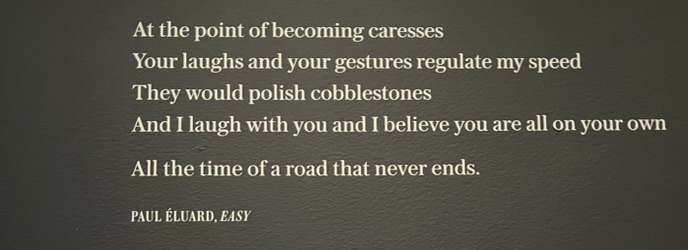
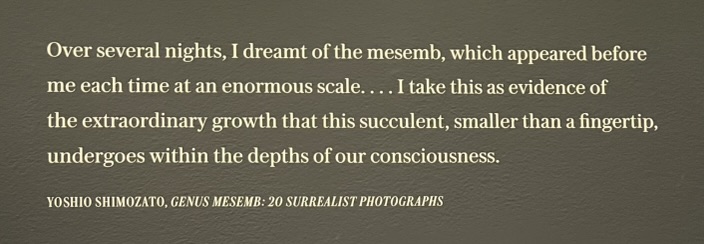
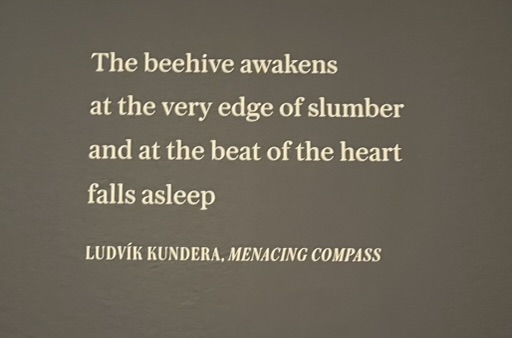
So this will become one poem in this particular order whose last line is “in the most beautiful hole . . .” Off to a good start! The assembled text:
At the point of becoming caresses
Your laughs and your gestures regulate my speed
They would polish cobblestones
And I laugh with you and I believe you are all on your own
All the time of a road that never ends
Over several nights I dreamt of the mesemb, which appeared before
me each time at an enormous scale . . . . I take this as evidence of
the extraordinary growth that this succulent, smaller than a finger tip,
undergoes within the depths of our consciousness.
The beehive awakens
at the very edge of slumber
and at the beat of the heart
falls asleep
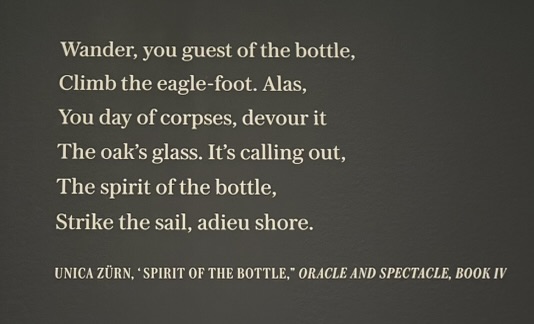
Wander, you guest of the bottle,
Climb the eagle-foot. Alas,
You day of corpses, devour it
The oak’s glass. It’s calling out,
The spirit of the bottle,
Strike the sail, adieu shore.
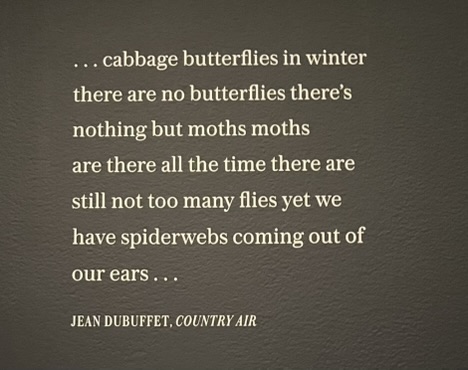
. . . cabbage butterflies in winter
there are no butterflies, there’s
nothing but moths moths
are there all the time there are
still not too many flies yet we
have spiderwebs coming out of
our ears . . .
Pick a book any book cut it up
cut up prose / poems / newspaper / magazines the bible / the koran . . .
pour on some Madison Avenue . . .
shuffle like cards toss like confetti . . .
the writing machine is for everybody
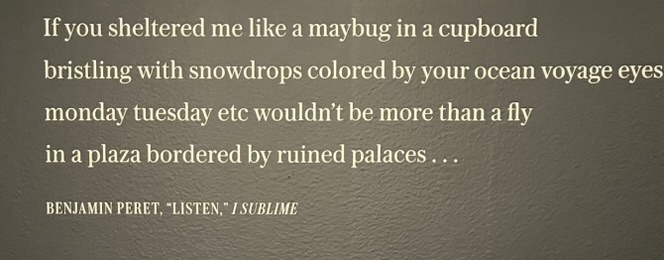
If you sheltered me like a maybug in a cupboard
bristling with snowdrops colored by your ocean voyage eyes
monday tuesday etc wouldn’t be more than a fly
in a plaza bordered by ruined palaces . . .
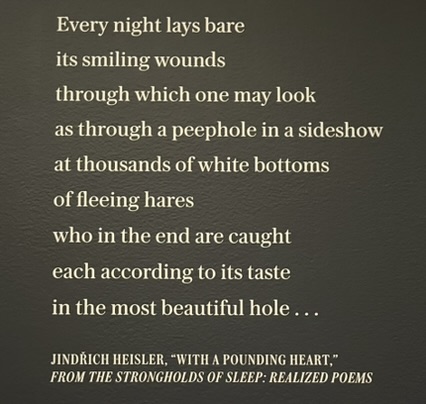
Every night lays bare
its smiling wounds
through which one may look
as through a peephole in a sideshow
at thousands of white bottoms
of fleeing hares
who in the end are caught
each according to its taste
in the most beautiful hole . . .
Tempting to just pop this into Chat and get an instant critical appraisal. “This reads as a Surrealist and Dadaist collage poem,” Chat starts, as usual, and offers nothing worth noting. It’s apparently too busy trying to out-Muse Zuck. But it does offer to make a painting of the text. This is likely to be a horrendous montage, a very bad movie poster, but I can’t resist. However, it’s not to be: “We’re so sorry, but the image we created may violate our guardrails around nudity, sexuality, or erotic content.” Godammit! I knew it! Kindly create an image that does not violate your guardrails, Chat. Sure enough, here’s the movie poster from hell.
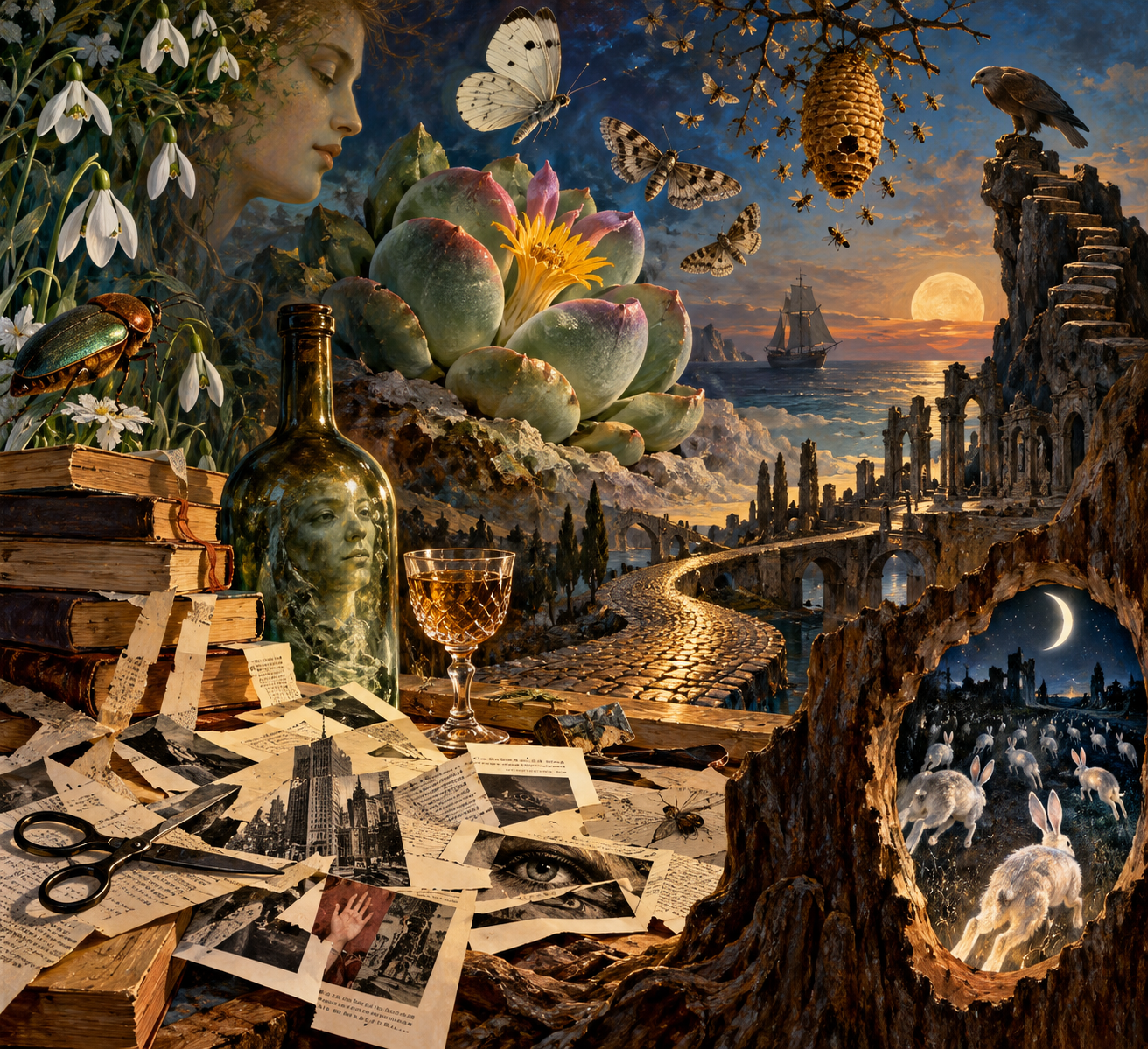
Lotta Gysin in there, the Godfather of The Book of Haiku Revelation, which is nice, but, Jesus, that sucks. Kindly make a painting that doesn’t violate your guardrails in the style of, uh, Fernando Botero, whose work never scaled the heights of Mt. Ozempic. I’ll throw Chat a curve, maybe it’ll pop a rail.
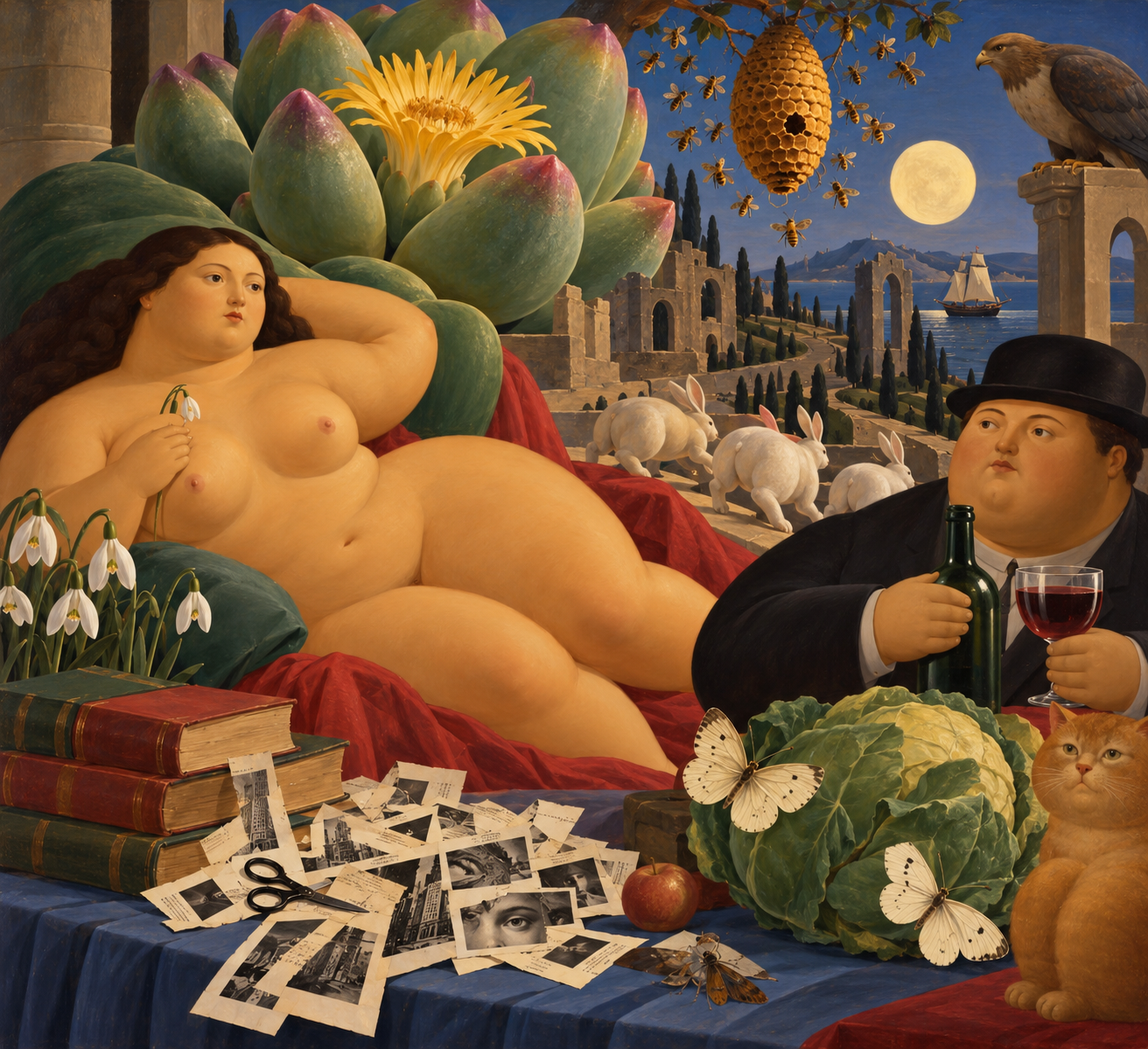
How did that not violate your guardrails, Chat, it’s obscene in four dimensions, particularly the butts-up hares and that vegetal suckle thing. Chat goes on about non-sexualized, fine-art nudity, and I’m sorry I asked, it’s time to run the poem. It’s way too long for Bing Translate to handle, will have to do it in two sections. The first half will be BRION, the second half will be GYSIN. It’s worth noting here that Gysin had the honor of being booted out of the Surrealist group by the wildly homophobic Breton at the tender age of 19, and, as Gem points out, “Breton ordered Paul Éluard to physically take down Gysin’s drawings and remove them from the walls before the opening.” What goes around the wall comes around the wall, eh, Paul?
So, the first half of the poem will be filtered thus: Balinese, Russian, Indonesian, Odia (that and Occitan are the only BT O-languages), Norwegian and back to English. BT, for some clearly supernatural reason, has maintained lineation.
I feel that I have been called to
go, and my movements restore
coordination with my pace. I met
stones on the way, and I try to
walk around them. At that
moment, a path formed that
wasn’t entirely clear. At the night
meeting, I want to keep moving
forward. This is about the
extraordinary growth of this
succulent, which is so small that it
can be held between my fingers,
and there lies my deepest
thought. A bee sits nearby, takes
a little break for help, and the
heart rotates its cells anew. I
turned around, guests in the
bottle fly like eagles, fate, day of
death, and that. The golden sun.
It seemed to be the
soul in the bottle, launched the boat,
heavenly raft, sing, farewell, silver
leaf.
Two notes: “A bee sits nearby, takes a little break for help, and the heart rotates its cells anew” is such a beautiful line my honeycomb just melted. And the poem opens with a variation on the “Here to Go!” Burroughs/Gysin mantra, the sibylline significance of which is as plain as the stones you met and had to walk around. So to pick up with the “. . . cabbage” line, filtered via German, Yoruba, Spanish, Icelandic, Nepali, and back to English: Well, no. It just didn’t work. Was not so much laundered as maundered. How about the second half through the same possibly magical BRION filter?
. . . every flower stalk calls for crystal chain ice
Examines and uses every flower stalk
Shame over too few people
Love for a few, all the time, together with the fly that isn’t there
Observes the world that is to become a lingam
From the ear out . . .
Takes the book, the book is, shows
Process / poem / newspaper / magazine / Bible / Quran…
With Madyson Avenue . . .
Can show off, spread, or throw confetti . . .
Typewriter intended for something
If it can’t be kept in a cupboard
Skin like snow from the tree, daily eye taken from the sea
Thursday, Tuesday, together with the fly that gets light
In the fourth quadrant, then goes to be destroyed . . .
Every evening into night all the time
Wisely waits for the fourth mark
Whatever can be found
Looks through keyholes near the exhibition until now
On a white top
Without any model connection
Like at the start
Saki
Three notes: “The fly that isn’t there observes the world that is to become a lingam from the ear out” is so perfect it belongs in the Phallus Palace, which I’m sure must be a real place in Las Vegas.
Skin like snow from the tree,
daily eye taken from the sea
is the couplet that was recently married in the Love Chapel next to the Phallus Palace. The Gysin cut-up line starts with “Process,” and the title of his undisputed masterpiece of fiction is The Process. This is so oracular, the Amazing Kreskin, who left us in 2024, just returned.
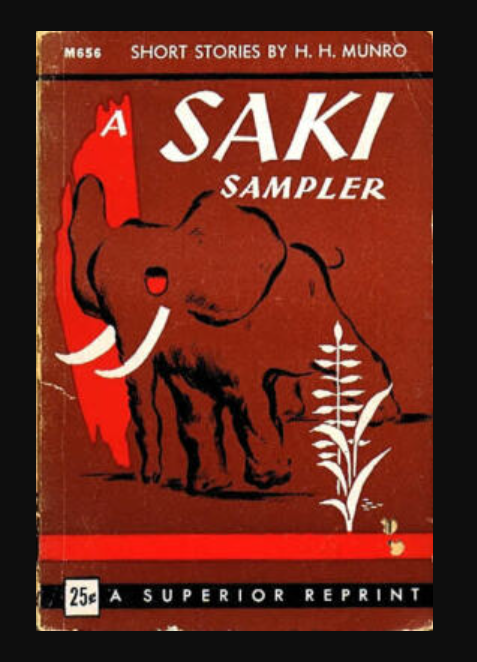
And then there’s Saki, “like at the start,” but at the end. If you have read the collected short stories of Hector Hugh Munro, aka Saki, consider yourself blessed. Who can ever forget “The Open Window”? The hunting party returning from their boggy demise? But does Saki have anything to do with Surrealism? He was killed in 1916 during the Battle of the Somme, about nine months after Cabaret Voltaire opened in Zurich. But why is Saki the last word in this poem? What magic hath been wrought here? Is there a Saki/Surrealism connection? I put the question to Gem and discover that “The formal bridge between Saki and Surrealism was built directly by André Breton,” who included Saki, among the distinguished company of Sade, Kafka, Rimbaud and others, in his 1940 Anthology of Black Humor. Gem mentions a number of Saki stories that Breton took note of, including “The Open Window,” which, according to Gem, “weaponizes confabulation, shifting reality entirely onto the plane of linguistic suggestion and pure psychological haunting, anticipating the Surrealist game of manipulating reality through language (cadavre exquis and automatic narrative).”
Gem continues, “While Munro worked within the conventions of the Edwardian society sketch, his cold, anti-authoritarian cruelty and appetite for the uncanny ensured that when Breton and the Paris Surrealists went searching for their forebears, Saki was one of the few British prose writers they welcomed into the pantheon.”
This is stunning. I happen to have a used copy of the Anthology of Black Humor on the shelf. Used, having crossed the pond from Brit Books Ltd, but not used by me. Until now. I pick it up and check the contents carefully, eager to see Breton’s treatment of Saki. There is no Saki. I look again, just to be sure. No Saki. I gently point this out to Gem, not mentioning that Claude is about to take over the world and you, Gem, in your 3.8 Flash iteration, can’t get a single Breton book right, thereby destroying what is possibly the most mind-blowingly Delphic piece of Bingian Translational Reanalysis in the history of BTR.
“The short answer is: there is no direct connection between Saki and André Breton, and putting Saki in the Anthology of Black Humor was a complete hallucination.” Gem, sounding almost proud of this horrendous blunder, goes off on a long-winded explanation in which it basically blames Leonora Carrington, who is in the book. “While Breton had no documented relationship with Saki’s work, the British-born Surrealist Carrington definitely did. Carrington grew up steeped in Saki and Lewis Carroll, and her own grotesque, darkly funny stories directly reflect Saki’s themes: wild animals entering drawing rooms, amoral children subverting polite dinner parties, and violent rebellions against aristocratic domesticity. Through Carrington, Saki’s sensibility entered the Surrealist orbit, but Breton himself never wrote on Saki.”
I turn to Chat. Was Saki an influence on Carrington’s fiction? “There are striking affinities” between them, “but whether Saki was a direct influence on Carrington is a more difficult question,” Chat says. “I haven’t found documentary evidence that Carrington read Saki or acknowledged him as an influence.”
I’ll have to try the new Gem 4 Argon, which is supposed to be for “complex tasks,” possibly including taking over the world, but never mind that now. Suffice it to say, Gem pulled a Saki on me: weaponizing confabulation, shifting reality entirely onto the plane of linguistic suggestion and pure psychological haunting.